
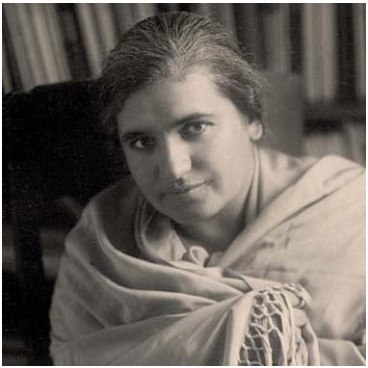
Zenta Mauriņa
1897 – 1978
- Cemetery
- Bad Krozingen, Germany
Zenta Mauriņa wrote essays, literary studies and prose that explored culture, human dignity and the challenges of living. Childhood polio left her with lasting mobility impairment, but her intellectual and public life extended across languages and national borders. She studied literature, lectured and translated, bringing Latvian readers into conversation with European writers. Exile after the Second World War took her to Sweden and later Germany, where she continued writing and speaking to audiences. Her career combined intellectual ambition with persistence in the face of substantial obstacles. She died in Basel in 1978. Mauriņa was born in Lejasciems, in northeastern Vidzeme, on 15 December 1897. She acquired German and Russian in childhood and graduated from the Russian Women’s Gymnasium in Liepāja in 1915. After completing her studies at the University of Latvia in 1928, she became a lecturer there. In 1929, she pursued further study in philosophy and literary scholarship at Heidelberg. Her academic work was accompanied by editing literary periodicals and other publications, as well as writing articles on Latvian prose and poetry. These activities brought her into both university teaching and the wider literary public. [2] A writer’s personality occupied a central place in her critical approach: she used it as a point of departure for examining the distinctive qualities of creative work. At the same time, she followed Western European debates about aesthetics and addressed contemporary questions in literary scholarship through reviews and theoretical articles. Her essays joined literary analysis with ethics and the philosophy of culture. Collections from this period included Contemplations and Ideas in 1934 and Conformations of Life in 1935. In the Light of Prometheus followed in 1943, continuing her work in the literary-philosophical essay. [2] Her studies of Dante and Dostoyevsky were particularly prominent within her engagement with foreign literature. The Dostoyevsky monograph first published in 1931 was subsequently expanded and appeared in English in 1936 as A Prophet of the Soul: Fyodor Dostoyevsky. Her doctoral research turned to a Latvian poet. In 1938, she defended a dissertation on the worldview of Fricis Bārda at the University of Latvia. The examination lasted five hours. She became the first woman in Latvia to obtain a doctorate through a dissertation on a literary subject, an achievement greeted by hundreds of well-wishers. [2] In Florence in 1936, Mauriņa married Konstantīns Raudive, who was eleven years younger and had studied in Paris. He had also translated Miguel de Unamuno’s novel Fog. They left for Germany in the winter of 1944 and moved to Sweden in 1946, where she lectured at Uppsala University. Raudive accompanied her on European lecture journeys and provided physical assistance, including carrying her. She returned to Germany in 1965 and settled in Bad Krozingen. Her professional life in exile thus combined university employment, public speaking and sustained literary production across several countries. [2] During the 1950s, her audiences in Germany, Austria and Switzerland heard lectures on European cultural inheritance, solitude, love, illness and Russian literature. She also researched and discussed anti-Soviet writing, delivering more than fifty lectures about Alexander Solzhenitsyn in European cities. Her essays considered Communist and Nazi terror and the experiences of Latvians in the twentieth century. Bridges and The Mosaic of Heart appeared in 1947, followed by The Secret of Pain in 1952 and Latvian Essays in 1953. These publications became associated with intellectual resistance and efforts to maintain international awareness of Latvia. [2] Mauriņa’s later autobiographical trilogy comprised The Far Journey, published in 1955, Daring is Beautiful in 1958, and The Steel Bolts Are Breaking in 1960. Alongside her own experience, she portrayed cultural figures she had encountered. Her broader output included the novels In the Train of Life and Three Brothers, short-story collections, and translations of Dostoyevsky, Romain Rolland and Sigrid Undset. Across her lifetime she wrote nearly one hundred books, becoming one of the most widely translated Latvian authors. Following her death on 25 April 1978, she was buried in Bad Krozingen, the German town where she had spent her later years. [2]
The book A Hundred Great Latvians, which includes this person, can be purchased here.
The map marker shows the cemetery; the exact grave position is not yet established.
Sources & Further Reading
Books
- [2] Apinis, P. A Hundred Great Latvians. Nacionālais apgāds, Riga, 2006, pp. 112-113. ISBN 9984-26-288-X.