
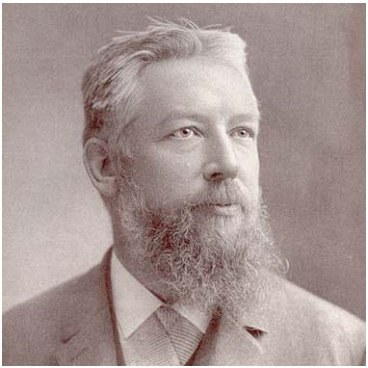
Wilhelm Ostwald
1853 – 1932
- Kapsēta
- Großbothen, Germany, as reported by the book
Born in Riga, Wilhelm Ostwald became a leading figure in the emergence of physical chemistry. His teaching and research in Riga and Leipzig helped connect chemical reactions with quantitative ideas about energy, equilibrium and rates of change. The Nobel Prize in Chemistry awarded to him in 1909 recognised work on catalysis, chemical equilibria and reaction velocities. Ostwald also helped build the discipline’s institutions through publications, laboratories and the training of researchers. His interests later extended to philosophy, colour and the organisation of scientific knowledge. His inclusion in this collection reflects Latvia’s history as a place of intersecting languages and communities: he was a Baltic German scholar with an international career. Describing that connection accurately is more useful than assigning him an identity that erases its complexity. Ostwald’s education began at Riga’s Dome School and Real Gymnasium. Born on 2 September 1853 into the family of a cooper, he went on to complete a chemistry course at Dorpat, now Tartu, in three years. He defended his master’s thesis in 1877 and his doctorate the following year, subsequently receiving the title of assistant professor. Dorpat offered substantial laboratory and library resources, but its leading academic positions were already occupied. In 1881, he accepted a professorship at Riga Polytechnicum, where he remained for five and a half years. [2] His appointment brought substantial changes to chemical education in Riga. Student numbers tripled, teaching was modernised, and a dedicated laboratory building was constructed. Ostwald also designed and made laboratory apparatus, some of which remained applicable long afterward. His output during these years included thirty original scientific publications and a textbook of general chemistry. These activities placed equipment, instruction and publication alongside experimental investigation. The institution itself had been founded in 1862 on German and Swiss models and employed teachers from several countries, providing an international setting for his work. [2] Several important investigations took shape during the Riga period. In 1884, Ostwald demonstrated fundamental laws governing homogeneous acid-base catalysis. Svante Arrhenius worked under him there and experimentally supported the free-ion theory associated with his later Nobel recognition. Ostwald also developed foundations for research into chemical equilibrium and catalysis. In 1887, he became the first publisher and editor-in-chief of Zeitschrift für Physikalische Chemie, contributing articles, reports and reviews himself. The journal’s establishment coincided with theoretical advances by Arrhenius and Jacobus Henricus van’t Hoff, giving the emerging field a specialised forum for its research. [2] The final Riga years also brought institutional difficulties. From 1885, Russian government policies of Russification required Ostwald to lecture in Russian, and his relationship with the Russian Society for Chemistry and Physics deteriorated. In 1887, he visited twenty laboratories in Germany and Switzerland, developing direct contacts with leading chemists, and received an offer from Leipzig University. There he established a major centre for physical chemistry. His subsequent achievements included a theoretical framework for analytical chemistry, a revised understanding of catalysis and the dilution law bearing his name, whose foundations had already been developed in Riga. [2] Ostwald’s research also had industrial applications. With E. Brauer, he developed a process for the catalytic oxidation of ammonia used in producing fertilisers and explosives. His international scientific school included figures associated with Riga, such as Karl Adam Bischof, Paul Walden and Gustavs Vanags, as well as researchers in Germany including Ernst Beckmann and Max Bodenstein. From 1905, he lived at Großbothen near Leipzig and pursued research privately. His philosophy of energetics treated energy as the fundamental reality, although he later accepted atomism. He devoted part of his Nobel award money to investigating energy loss. [2] His later activities ranged beyond laboratory chemistry. In 1911, he proposed a system of paper sizes that preceded the German DIN formats introduced in 1922. He also advocated a shared world language and currency, supported peace before and during the First World War, and became associated with the early development of standardisation. In his final years, colour research occupied an important place in his work. Ostwald died in Leipzig on 4 April 1932 and was buried at Großbothen. His documented legacy encompassed scientific methods, teaching networks, publishing and proposals intended to organise everyday practices more systematically. [2]
Grāmatu “100 Latvijas personību”, kurā iekļauta arī šī personība, var iegādāties šeit.
The map marker shows the cemetery; the exact grave position is not yet established.
Sources & Further Reading
Books
- [2] Apinis, P. A Hundred Great Latvians. Nacionālais apgāds, Riga, 2006, pp. 36-37. ISBN 9984-26-288-X.