
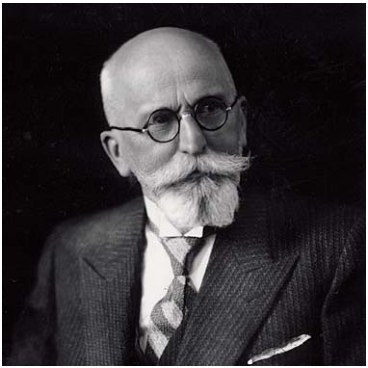
Vilhelms Purvītis
1872 – 1945
- Kapsēta
- Forest Cemetery / Meža kapi, Riga, Latvia; reinterred with his wife in 1994
Vilhelms Purvītis made the northern landscape a central subject of Latvian painting. Snow, thawing water, trees and changing light became the material through which he explored colour and structure. His international training did not displace attention to the landscape of home. Purvītis was also an institution-builder. He directed art education in Riga and became the first rector of the Art Academy of Latvia, influencing generations of painters through his landscape workshop. War forced him to leave Latvia, and he died in Germany in 1945. His remains were returned in 1994. The reburial connects his personal history of displacement with the later effort to restore cultural memory in independent Latvia. Born on 3 March 1872 at the Jauži farmstead near Zaube, Purvītis pursued his professional education in St Petersburg. He completed A. Kuindzhi’s landscape workshop at the Imperial Academy of Arts in 1897, receiving a first-class artist’s qualification and the academy’s Great Gold Medal. While still studying, he contributed to the Latvian Ethnographic Exhibition in Riga in 1896. Together with Ādams Alksnis, he organised Rūķis, an association seeking an independent direction for Latvian art. Its members included Janis Rozentāls, Jānis Valters, Jūlijs Madernieks and Rihards Zariņš. [2] Further study took him to Germany, France and Italy in 1899. Recognition abroad followed: his diploma painting, Pirmie stari (The First Rays), received a bronze medal at the Paris World Exposition in 1900, and he won a gold medal at the Munich Secession exhibition the following year. Ziemas nakts (A Winter Night) and Marta saule (March Sun) also gained international awards. His exhibition activity extended across Germany, France, Russia and Latvia. In 1913, the Imperial Academy of Arts elected him an Academician, adding institutional recognition to the success of his paintings. [2] His working methods combined close observation with deliberate pictorial organisation. He depicted natural forms precisely but also gave them an emotional character, often using a light, restrained palette. Individual trees could become strong accents within a composition, establishing contrasting rhythms against the surrounding terrain. Thickly applied paint intensified effects of illumination. His style was not fixed: realism, impressionism, Art Nouveau, post-impressionism and expressionism all contributed to its development. During the 1920s he also painted small towns. By 1932, his output amounted to approximately two thousand works, including Pēdējais sniegs (The Last Snow), Atkusnis (The Thaw) and Kad silava mostas (When the Wood Awakes). [2] The development of advanced art education occupied him over many years. When he took charge of Riga City Art School in 1909, he was already considering the establishment of a higher institution for artists in Latvia. The First World War interrupted those plans. On 20 August 1919, the Cabinet of Ministers confirmed his appointment to lead the new academy, although teaching there began only in 1921. More than fifty artists graduated from his landscape workshop. Outdoor practice and sustained, methodical work formed the basis of instruction, alongside respect for each student’s individual approach. He also held a professorship in the University of Latvia’s Faculty of Architecture and supervised an art workshop there. [2] His public responsibilities extended to the care and presentation of art. As director of Riga City Art Museum from 1919 to 1940 and again from 1941 to 1944, he developed its Latvian Art Department and systematically enlarged the national collection. He organised exhibitions featuring both Latvian and foreign artists and directed major presentations of Latvian art abroad. Another substantial undertaking was his editorship of the three-volume Vispārīgā mākslas vēsture, a general history of art published between 1934 and 1936. [2] Purvītis received the Order of the Three Stars in 1928 and the Fatherland Prize in 1938. The survival of his artistic estate was less secure: twenty boxes of his works, dispatched by sea towards Königsberg in East Prussia, disappeared in transit. Paintings preserved in the Latvian National Museum of Art include Ziema (Winter), dating from around 1910, and landscapes from the 1930s. These surviving works stand alongside his educational and museum achievements as documented parts of his contribution to Latvian cultural life. [2]
Grāmatu “100 Latvijas personību”, kurā iekļauta arī šī personība, var iegādāties šeit.
The map marker shows the cemetery; the exact grave position is not yet established.
Sources & Further Reading
Books
- [2] Apinis, P. A Hundred Great Latvians. Nacionālais apgāds, Riga, 2006, pp. 64-65. ISBN 9984-26-288-X.