
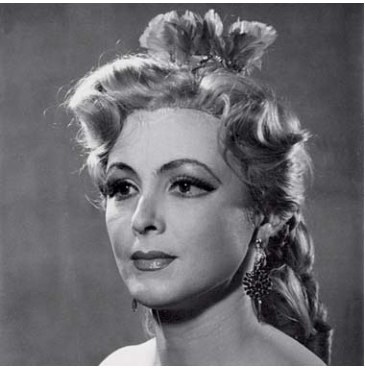
Vija Artmane
1929 – 2008
- Kapsēta
- Burial location not verified in this record
Vija Artmane developed a prominent career in Latvian theatre and Soviet cinema. Her long association with the Daile Theatre provided a setting for roles that moved from young heroines toward more complex dramatic characters. Film extended her reputation to much wider audiences. Her performances included adaptations of Latvian literature as well as productions made elsewhere in the Soviet Union. The different demands of stage and screen make the breadth of that career significant. Born in Tukums District on 21 August 1929, Artmane attended Riga Secondary School No. 3 before completing the Daile Theatre’s second studio in 1949. She then joined the theatre’s company. Early appearances included Abigail in Eugène Scribe’s The Glass of Water and Eliza in George Bernard Shaw’s Pygmalion. The chapter identifies her voice, movement and stage presence as notable features of these performances. Her training and first professional engagements placed her within the theatre shaped by Eduards Smiļģis, whose directing principles remained important to her work. [2] During the 1950s, Artmane played Nina in Mikhail Lermontov’s Masquerade, Ilze in Rūdolfs Blaumanis’s The Prodigal Son and Baiba in Rainis’s Blow, Wind! In 1953 she appeared as Juliet opposite Eduards Pāvuls’s Romeo in a production directed by Smiļģis. Harijs Liepiņš was another important partner, particularly in leading roles from the Latvian repertoire of Blaumanis and Rainis. These collaborations formed part of a sustained company career in which Artmane performed approximately two hundred characters between 1949 and 1998, most of them leading parts. [2] Her repertoire also encompassed markedly different figures from European drama and literary adaptations. She portrayed Hélène Bezukhova in War and Peace, Beatrice in Much Ado About Nothing, Eva in Brecht’s Squire Puntila and His Servant Mati, and Nastasya Filipovna in The Idiot. In 1973 she played Maxine Faulk in Tennessee Williams’s The Night of the Iguana under Arnolds Liniņš. Three years later she appeared as Arkadina in Chekhov’s The Seagull, directed by Kārlis Auškāps and Liniņš. These productions required work across contrasting dramatic traditions rather than a single recurring character type. [2] Artmane’s screen career began in 1956 with Rita in the Riga Film Studio production After the Storm. Subsequent roles included Sonya in the Russian film Family Blood in 1964 and Ona in the Lithuanian production Nobody Wanted to Die in 1966. That same year she played Kristīne in Leonīds Leimanis’s adaptation of Blaumanis’s Purva bridējs. Her work brought awards at Soviet film festivals, and in 1969 she received the honorary title of National Artist of the USSR. Employment across several studios widened the audience for both her dramatic and character performances. [2] A particularly well-known screen role was Julia Lambert in Jānis Streičs’s 1978 film Theatre, adapted from the novel by W. Somerset Maugham, with Ivars Kalniņš as Tom Fennel. Riga Film Studio made a documentary about her, Conversation with the Queen, in 1980. That year she also played Queen Elizabeth on stage opposite her husband, Artūrs Dimiters, as Cecil in Ferdinand Bruckner’s play. Beyond acting, she held seats in the Latvian SSR and USSR Supreme Soviets and belonged to the Soviet Peace Defence Committee, participating in the public institutions of the period. [2] Later theatre work included a portrayal of Zenta Mauriņa in The Heart Has Wings in 1997, directed by Ģirts Nagainis and based on Mauriņa’s life and writings. From 1998 to 2000 Artmane worked at the New Riga Theatre, appearing in the title role of Alvis Hermanis’s 1998 production of Pushkin’s The Queen of Spades. In 2004 she published the memoir Ziemcieši. Mirkļi no manas dzīves. Its recollections addressed personal happiness and tragedy alongside encounters with fellow actors and people close to her, adding her own account to the record of her performances. [2]
Grāmatu “100 Latvijas personību”, kurā iekļauta arī šī personība, var iegādāties šeit.
The resting place has not yet been established.
Sources & Further Reading
Books
- [2] Apinis, P. A Hundred Great Latvians. Nacionālais apgāds, Riga, 2006, pp. 148-149. ISBN 9984-26-288-X.
Web resources
- [1] Vija Artmane