
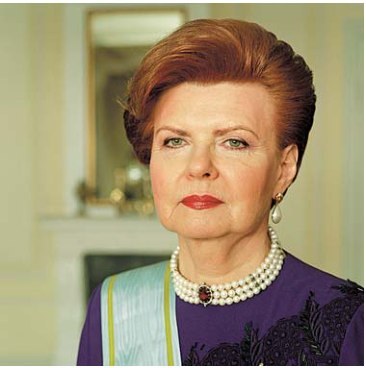
Vaira Vīķe-Freiberga
1937 –
Vaira Vīķe-Freiberga's life connects wartime displacement, academic research and the restoration of Latvia's place in European public life. After leaving Latvia as a child, she eventually built a career in Canada as a psychologist and scholar of Latvian folk songs. She served as Latvia's president from 1999 to 2007, becoming the first woman to hold that office. Her presidency included the country's accession to the European Union and NATO in 2004. Her international advocacy drew on experience across languages and cultures. Alongside that political legacy, her study of the dainas remains an important part of her intellectual work, linking the analysis of traditional poetry with questions of memory and identity. Born in Riga on 1 December 1937, Vīķe-Freiberga received her early schooling in several countries after her family’s departure from Latvia. She attended a Latvian school in Lübeck, Germany, and a French school in Casablanca, Morocco, before moving to Canada in 1954. There she also worked within the Latvian community as an educator and folklore specialist. At the University of Toronto she earned a bachelor’s degree in philosophy in 1958 and a master’s degree in psychology in 1960. McGill University awarded her a doctorate in experimental psychology in 1965. [2] From 1965 to 1998, she taught at the University of Montreal, covering psychopharmacology, psycholinguistics and scientific theory. Her research addressed memory, language, cognition and the effects of drugs on human beings. Alongside these fields, she examined the psychological experience of exile and questions of Latvian identity. Essays written between 1968 and 1991 were collected in the 1993 volume Against the Current. During her research career she visited Latvia repeatedly and maintained contacts with scientists and cultural figures there, continuing scholarly exchanges while living in Canada. [2] Her investigation of folk poetry included both textual interpretation and the organisation of substantial research resources. Working with her husband, Imants Freibergs, she developed the Boston–Montreal Dainas Database, containing 71,000 songs, and a separate collection of 4,000 sun songs. Publications included Latvian Sun Songs in 1988 and studies of folk-song linguistics, poetics and interpretation in 1989. The three volumes of The Threefold Sun appeared in 1997, 1999 and 2002, followed by Latvian Sun Song Melodies in 2005. This work examined the forms and structures of traditional verse as well as its recurring subject matter. [2] Her Canadian career also involved scientific administration and international consultation. In 1980 she became chair of a human-factors panel within NATO’s scientific programme, serving as Canada’s appointed representative. From 1984 to 1989 she was vice-president of the Science Council of Canada, an appointment made by the governor general. In 1989 she represented Canada as a consultant to the Brazilian parliament’s commission on constitutional reform. Recognition included an honorary doctorate in law from Queen’s University in 1991 and a Killam Research Fellowship supporting her work from 1993 to 1995. [2] On 19 October 1998 she returned to Latvia and became director of the Latvian Institute. Parliament elected her president on 17 June 1999, and she assumed office on 8 July; her re-election followed on 20 June 2003. The office included chairing the National Security Council and serving as commander-in-chief of Latvia’s armed forces. Her public activity also encompassed economic and social discussions, cultural occasions and interviews conducted in Latvian, French, English, Spanish and German. The chapter documents an approach to the presidency involving extensive participation in both domestic affairs and international representation. [2] Among the diplomatic milestones recorded during her presidency were the November 2002 NATO summit in Prague, where the decision on Latvia’s admission was taken, and the completion of European Union accession negotiations in Copenhagen that December. Cultural representation remained part of her public responsibilities alongside these negotiations and decisions. Her scholarly contribution had already received the World Federation of Free Latvians’ Culture Foundation prize in 1989 and the Latvian Academy of Sciences Grand Medal in 1997. Awarded the Order of the Three Stars in 1995, she became its Grand Cross commander in 1999. [2]
Grāmatu “100 Latvijas personību”, kurā iekļauta arī šī personība, var iegādāties šeit.
Sources & Further Reading
Books
- [2] Apinis, P. A Hundred Great Latvians. Nacionālais apgāds, Riga, 2006, pp. 174-175. ISBN 9984-26-288-X.