
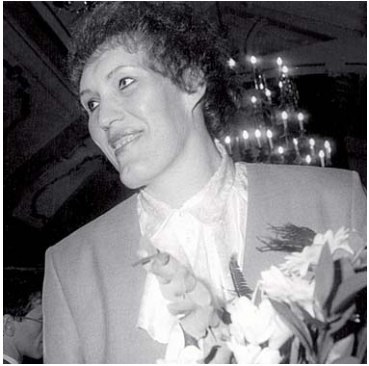
Uļjana Semjonova
1952 – 2026
- Kapsēta
- First Forest Cemetery / I Meža kapi, Riga, Latvia
Uļjana Semjonova became one of the most influential figures in women's basketball. Her career with TTT Riga and the Soviet national team included sustained success at club and international level. She won Olympic gold in 1976 and 1980. Her presence near the basket was important, but the record also reflects training, teamwork and the development of an exceptionally successful basketball programme. After her playing career, she remained associated with support for former athletes. Her place in Latvian sporting memory extends beyond the medals: she became a widely recognised representative of the country's basketball tradition. She died in January 2026. Born on 9 March 1952, Semjonova spent her childhood in Medumi, near Daugavpils. By thirteen she was already approaching two metres in height, attracting the attention of coaches who brought her to Riga and introduced her to basketball training. Her education continued alongside competitive sport: while playing for TTT and the Soviet national team, she graduated from the Latvian State Institute of Physical Culture. Her eventual height of 210 centimetres was accompanied, in the chapter’s assessment, by agility and a sustained effort to improve her playing skills. [2] The club she joined belonged to an established Latvian basketball environment. Riga ASK had achieved major European successes before the women’s team accumulated its own extensive record. TTT’s first coach was Oļģerts Altbergs; Raimonds Karnītis later took charge and coached the team from 1962 to 1987. Karnītis had himself captained ASK to a European Cup victory. Under his direction, Semjonova’s physical abilities became an important element of the team’s play. Her development thus took place within a coaching tradition linking Riga’s successful men’s and women’s basketball programmes. [2] TTT’s institutional record included twenty-one Soviet championship titles and eighteen victories in the European competition for champion clubs. Representing the Latvian SSR, the team also won six titles at the Soviet Spartakiad, the large multisport competition held within the USSR. These totals belong to the club’s history rather than exclusively to Semjonova’s personal career. Her own record included three world championships and nine European championships with the Soviet national team, while the chapter credits her with ten European champion-club cups. She also served as TTT’s captain. [2] Her career choices were shaped in part by the organisation of Soviet sport. Coaches from Moscow and Leningrad sought to recruit her, offering money, a car and an apartment, but she continued to play for TTT. Soviet officials prevented her from pursuing a place in the professional league in the United States. The chapter also records that Karnītis, despite his club’s repeated victories, was never appointed to coach the Soviet national team. In 1984 the Soviet boycott of the Los Angeles Games removed another opportunity for Olympic competition. [2] International recognition later placed Semjonova’s achievements in a setting beyond Soviet competitions. She entered the Basketball Hall of Fame in Springfield, Massachusetts, in 1993 and also received an international Fair Play award. Latvia honoured her with the Order of the Three Stars in 1995. The presentation brought together President Guntis Ulmanis and Latvian Olympic Committee president Vilnis Baltiņš. These distinctions recognised a playing career whose reputation extended beyond Riga, while the Hall of Fame provided a lasting institutional record of her standing in the sport. [2] From 1991, Semjonova participated in the Latvian Olympic Committee and led the Social Fund for Latvian Olympians. Her work included assistance to former competitors; the chapter shows her greeting Alberts Riekstiņš, a participant in the 1936 Winter Olympics, on his jubilee. She was also a senator of the Latvian Olympic Academy. Younger players encountered her through girls’ tournaments involving Latvian and Lithuanian teams competing for a cup bearing her name and that of A. Rupšiene. Having spoken little Latvian at school, she also became closely integrated into Latvian public life through sport. [2]
Grāmatu “100 Latvijas personību”, kurā iekļauta arī šī personība, var iegādāties šeit.
The map marker shows the cemetery; the exact grave position is not yet established.
Sources & Further Reading
Books
- [2] Apinis, P. A Hundred Great Latvians. Nacionālais apgāds, Riga, 2006, pp. 198-199. ISBN 9984-26-288-X.