
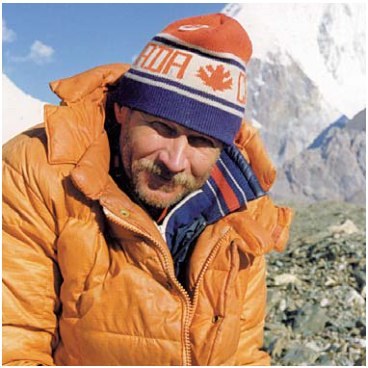
Teodors Ķirsis
1942 – 2003
- Kapsēta
- Burial location pending verification
Teodors Ķirsis combined an engineering background with a sustained commitment to mountaineering. In 1995 he reached the summit of Everest with Imants Zauls, an important moment in the history of Latvian climbing. Expeditions to major mountains on different continents formed the wider course of his climbing life. High-altitude travel required planning, endurance and cooperation as well as technical skill. His achievements helped make Latvian participation visible within an international mountaineering community. He died in December 2003 during a descent on Aoraki / Mount Cook in New Zealand, in an accident that also killed his daughter Evija and two other Latvian climbers. His biography encompasses both accomplishment and the loss experienced by that community. Born in Jelgava on 25 November 1942, Ķirsis pursued his higher education at Riga Polytechnical Institute, the institution later known as Riga Technical University. He completed his studies there and subsequently obtained a doctorate. Scientific work and teaching remained part of his professional life alongside climbing. The chapter’s photographic record places his first summit in the Central Tian Shan on 29 July 1968, providing an early dated point in a mountaineering career that would extend over more than three decades. [2] His early achievements developed within the geographical and political limits of the Soviet period. Ordinary Soviet citizens generally faced restrictions on foreign travel, and his climbing record initially centred on mountains within the USSR. In 1989 he ascended the 7,495-metre summit now called Ismail Samani Peak, then known as Communism Peak, in the Central Pamir. By 1991 he had climbed every Soviet summit exceeding 7,000 metres. Across his career, he led approximately fifty expeditions, combining his own ascents with responsibility for organised climbing parties. [2] The removal of Soviet-era travel barriers opened a broader field of expeditions. In 1993 he reached Dhaulagiri, at 8,167 metres, his first summit above the 8,000-metre threshold. Imants Zauls, who had been his regular climbing companion since the early 1980s, accompanied him on the series of continental high points completed by January 2001. These journeys were organised as national expeditions, and the Latvian flag was raised at each summit. The chapter presents the programme as a collective Latvian undertaking rather than solely a record of individual ascents. [2] Climbing techniques also gave Ķirsis a practical role in work on Latvian churches. He removed the old weathercock from the spire of Riga Cathedral and installed new weathercocks at Smiltene Church, Riga’s St John’s Church and other locations. A photograph records him working with Zauls and Pēteris Kūlis at Riga Cathedral on 16 May 1985. These assignments involved the application of mountaineering skills to elevated architectural structures, bringing work usually associated with distant mountains into the maintenance and renewal of familiar buildings in Latvia. [2] During the early Latvian National Awakening, Ķirsis, Zauls and Kūlis installed crosses on Riga’s Orthodox Cathedral of the Nativity of Christ. The crosses had been donated by Valdemārs Feldmanis, a Latvian living in Germany. This work formed another documented connection between his technical abilities and the country’s religious buildings during a period of public change. His wider achievements received state recognition in 1996, when he was awarded the Order of the Three Stars, a year after the Latvian expedition’s success on Everest. [2] Ķirsis also recorded mountain landscapes through film, photography and books. His activity therefore extended beyond reaching summits to producing visual and written accounts of the environments in which he climbed. Long-standing partnerships recur throughout this record: besides his association with Zauls, Aivars Prošenkovs had accompanied him in the mountains since 1978. The chapter preserves photographs from his beginnings in the Tian Shan, his major Asian ascents and his final expedition, documenting both the geographical range of his work and the companions who shared it. [2]
Grāmatu “100 Latvijas personību”, kurā iekļauta arī šī personība, var iegādāties šeit.
The resting place has not yet been established.
Sources & Further Reading
Books
- [2] Apinis, P. A Hundred Great Latvians. Nacionālais apgāds, Riga, 2006, pp. 184-185. ISBN 9984-26-288-X.