
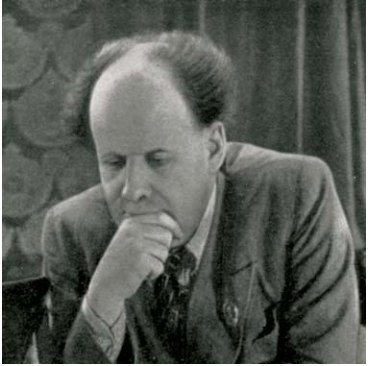
Sergei Eisenstein
1898 – 1948
- Kapsēta
- Novodevichy Cemetery, Moscow, Russia
Sergei Eisenstein, born in Riga, became an influential film director and theorist. His experiments with editing explored how the relationship between shots could create meaning and emotional force. Films such as Battleship Potemkin became major reference points in the history of cinema. His career developed in the Soviet Union and was closely connected with revolutionary themes, state commissions and censorship. Travel to the United States and Mexico widened his experience but also produced projects that were difficult to complete. His childhood in Riga connected his life with the city where his father Mikhail worked as an architect. Eisenstein was born on 23 January 1898 and attended Riga’s Realschule before continuing his education at the civil-engineering institute in Petrograd. The upheavals of 1917 placed him and his father on opposing political sides. Sergei supported the revolutionaries, serving first in a volunteer militia and subsequently in the Red Army. Mikhail served the White forces as an engineer and later emigrated to Germany. The contrast between their wartime allegiances forms a marked division within the family history presented in the chapter, alongside their different eventual fields of creative work. [2] Theatre provided an important stage in Sergei’s development before filmmaking. In Moscow, he studied with the theatre director Vsevolod Meyerhold and worked at Proletkult’s First Workers’ Theatre, where he became a director. His early film work included Strike in 1924 and, the following year, Battleship Potemkin. On the latter, he worked with cinematographer Eduard Tisse, who had been born in Liepāja. Their collaboration produced the film that the chapter places among cinema’s most highly regarded achievements. October followed in 1927, with Old and New appearing in 1929. [2] His approach to casting often departed from the use of established professional actors. He selected ordinary people whose appearance, background and way of life corresponded to the characters required by a film. His work also carried a strong commitment to Bolshevik ideology. Beyond particular revolutionary narratives, he believed cinema could convey abstract ideas and considered a film treatment of Karl Marx’s Das Kapital. The chapter therefore presents him not only as a maker of individual films but as a theorist concerned with the intellectual possibilities of the medium. [2] In 1930, Paramount Pictures invited him to the United States to work on an adaptation of Theodore Dreiser’s The American Tragedy. Disagreement over the selection of actors prevented the project from proceeding with him. He left Hollywood for Mexico, where he began the documentary Que Viva Mexico! That undertaking also remained incomplete when, in 1932, Stalin ordered him back to the Soviet Union. The two projects mark an international period in his career defined by an unsuccessful studio agreement followed by a documentary interrupted before its completion. [2] Alexander Nevsky, made in 1938, was his first sound film. Commissioned by Stalin, it depicted medieval Russia’s conflict with the Teutonic Order. The chapter links its delayed Soviet release to the political relationship between Germany and the Soviet Union following the Molotov–Ribbentrop Pact. It records that the film reached Soviet cinemas in 1941, after Germany attacked the country, and that Stalin then ordered widespread screenings. Its treatment of an earlier war thus became subject to changing state policy, with the timing and extent of its exhibition determined by the contemporary conflict. [2] Political control also shaped the reception of Ivan the Terrible. Its first part appeared in 1945 and received critical approval, but the Communist Party’s politburo rejected the second part. That instalment was not released until 1958; a planned third part remained unfinished. Eisenstein died following a heart attack in Moscow on 11 February 1948 and was buried in Novodevichye Cemetery. Although his career had taken him far from his birthplace, the chapter records his lifelong identification as a citizen of Riga. It also distinguishes his relatively small film output from the much wider influence of his theoretical and artistic contribution. [2]
Grāmatu “100 Latvijas personību”, kurā iekļauta arī šī personība, var iegādāties šeit.
The map marker shows the cemetery; the exact grave position is not yet established.
Sources & Further Reading
Books
- [2] Apinis, P. A Hundred Great Latvians. Nacionālais apgāds, Riga, 2006, pp. 114-115. ISBN 9984-26-288-X.