
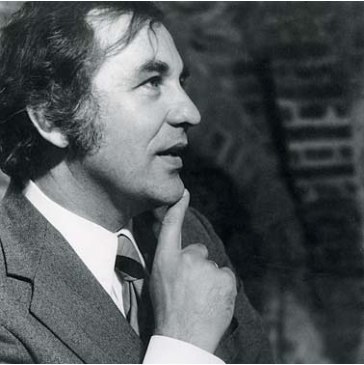
Rūdolfs Heimrāts
1926 – 1992
- Kapsēta
- First Forest Cemetery / Pirmie Meža kapi, Riga, Latvia; identified by Literatūra
Rūdolfs Heimrāts helped establish textile art as a major field of professional artistic education in Latvia. His tapestries combined attention to woven structure with imagery drawn from work, landscape and cultural tradition. He had experience in ceramics before concentrating increasingly on textiles. At the Art Academy of Latvia he developed teaching that influenced a new generation of artists, making his contribution institutional as well as personal. His work shows how techniques associated with domestic and decorative objects could support ambitious artistic statements. He died in 1992. Born in Jelgava District on 20 July 1926, Heimrāts completed his studies at the Riga State School of Arts and Crafts in 1948. He then entered the applied-art department of the Art Academy of Latvia, graduating in 1954. Although textiles became his principal field, ceramics remained part of his practice and he returned to it at intervals. His participation in exhibitions began in 1955. Over the following years, his work appeared both in Latvia and internationally, with exhibitions in countries including Belgium, Japan, Sweden, Italy, France, Canada and the United States. [2] The Latvian textile tradition he encountered already included experiments from the 1930s, when makers adapted ethnographic ornament for woven wall coverings using established tapestry methods. In the 1960s, his work To the Song Festival brought inherited applied-art practices into a new relationship with classical tapestry. The chapter identifies this work as an important change in the field. His subject matter encompassed labour, celebration, peace and attachment to the homeland, frequently expressed through imagery related to folklore. Female figures and motifs from nature were particularly prominent within his compositions. [2] The possibilities demonstrated by his work led to an invitation to establish a textile-art department at the academy. From 1961, its teaching covered a wide range of processes rather than weaving alone. Students learned tie-dyeing, fabric printing and painting, and textile mosaic, alongside the history of fabrics, weaving theory and textile chemistry. As a professor, Heimrāts trained many of the artists who subsequently worked in the field. The chapter attributes the emergence of a recognisable Latvian school of professional textile art to this combination of artistic example and systematic instruction. [2] His methods gave the woven surface an important role within the image. Loops, knots, braids and fringes supplied variations in texture, especially in figurative compositions. Light overall colouring and a poetic treatment of subjects also characterised his work. Alongside depictions of everyday activity and festive gatherings, he produced ornamental compositions with a distinct psychological atmosphere. He explored nearly the full range of textile genres and techniques, experimented with small-scale textiles, and sought unfamiliar materials and forms. Traditional tapestry and long-fringe methods were therefore parts of a practice that continued to expand. [2] This development took place amid increasing demand for substantial textile works in institutional and commercial interiors, including restaurants. Heimrāts followed international developments, and the search for new forms also affected artists in other disciplines as tapestry acquired spatial dimensions. Public recognition included a silver medal from the USSR art academy in 1971 and second prize at the applied-arts quadrennial in Erfurt in 1978. In June 1974, he held his first joint exhibition with his wife, the ceramic artist Frīda Heimrāte, at the Latvian Museum of Foreign Art. His tapestry Svētku deja was also exhibited at the Venice Biennale. [2] A solo exhibition in Moscow followed in 1977. Heimrāts became a corresponding member of the USSR art academy in 1983 and a full member in 1988. His family’s involvement in art extended to his son Mārtiņš, identified in the chapter as a graphic artist and president of the Artists’ Union of Latvia. Heimrāts died in Riga on 1 May 1992. His teaching did not end as an institutional influence with his death: the chapter records that his students continued the work under Professor Aija Baumane, carrying forward the educational tradition he had established. [2]
Grāmatu “100 Latvijas personību”, kurā iekļauta arī šī personība, var iegādāties šeit.
The map marker shows the cemetery; the exact grave position is not yet established.
Sources & Further Reading
Books
- [2] Apinis, P. A Hundred Great Latvians. Nacionālais apgāds, Riga, 2006, pp. 142-143. ISBN 9984-26-288-X.