
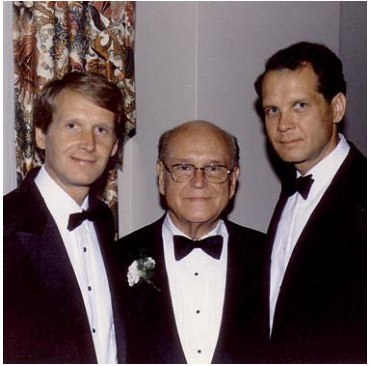
Richards Zariņš
1913 – 2006
- Kapsēta
- Burial location pending verification
Richards Zariņš served Latvian communities as a Lutheran minister through the upheavals of war and exile. Ordained before the Second World War, he later lived in Sweden and the United States. His pastoral work became closely connected with the needs of displaced people building new lives abroad. Practical assistance, community organisation and religious life were intertwined in that setting. He helped sustain networks through which Latvian refugees could find support and retain connections with their language and culture. His biography also forms the family background to the medical careers of his sons Bertram and Christopher. Born on 6 December 1913 in Gaujiena parish, Vidzeme, Zariņš studied theology at the University of Latvia. His ordination in 1938 was followed by service at Riga’s Dome Cathedral, where he remained until autumn 1944. A photograph from 1942 records him accompanying a procession of confirmands there. His departure for Sweden with his family occurred during the flight from Latvia as Soviet forces advanced. On 18 November 1946, he assumed leadership of the Latvian Evangelical Lutheran congregation in New York, beginning a ministry that would last more than fifty years. [2] The scale of the task soon became apparent at the New York waterfront. Between 1948 and 1952, Zariņš welcomed 287 arriving ships carrying, in total, more than 10,000 Latvian war refugees. The chapter describes newcomers who lacked money and possessions, did not know the local language, and could not readily resume their former occupations. His assistance included both personal reassurance and practical support. These repeated visits to incoming ships formed a substantial part of his work during the years when Latvian settlement in the United States was expanding. [2] Changes in the congregation’s membership show how closely its development followed that migration. From approximately 200 members in 1946, it reached 3,750 in 1966. The parish developed five districts, yet retained a common institutional identity rather than separating into independent congregations. Three ministers conducted Sunday worship at six sites. Keeping this dispersed membership within one parish was a central achievement of Zariņš’s long tenure, and the chapter places particular emphasis on the continuity of that arrangement as the church grew. Its geographical spread did not bring an end to its organisational unity. [2] The parish’s activities extended well beyond Sunday services. It maintained property, schools, choirs and camps, including a summer camp in the mountains attended by children. Together, these activities made the congregation an important centre of Latvian social and cultural life in New York. Zariņš also addressed audiences outside the immigrant community through regular broadcasts on Voice of America to Latvians living under Soviet rule. Alongside the local work of receiving newcomers and maintaining parish institutions, his ministry therefore included a documented channel of communication with people in Latvia. [2] Family photographs preserve another aspect of these years. In 1986, Richards and Marija Zariņš celebrated fifty years of marriage with their children Bertram, Antra and Christopher. Both sons pursued medical careers: Bertram in orthopaedics and sports medicine, and Christopher in vascular surgery. Their later activities connected medical institutions abroad with colleagues in Latvia. They organised the first worldwide congress of Latvian physicians in Riga in 1989, supported training opportunities and bursaries, and helped provide new medical technology. The chapter presents these professional contributions alongside their father’s work among refugees and parishioners. [2] Latvia awarded the Order of the Three Stars to Zariņš and separately to each of his sons. He died on 31 May 2006, leaving a record of service spanning cathedral ministry in Latvia, wartime displacement and decades of parish leadership in America. The chapter identifies the preservation of a united New York congregation as especially significant in that record. Its schools, choirs, camps and shared religious life document the institutional breadth of the community he helped sustain, while the figures for membership and refugee arrivals indicate the scale of the responsibilities he undertook. [2]
Grāmatu “100 Latvijas personību”, kurā iekļauta arī šī personība, var iegādāties šeit.
The resting place has not yet been established.
Sources & Further Reading
Books
- [2] Apinis, P. A Hundred Great Latvians. Nacionālais apgāds, Riga, 2006, pp. 180-181. ISBN 9984-26-288-X.