
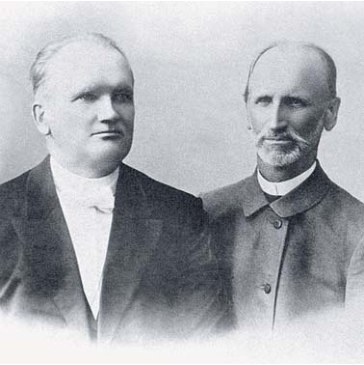
Reinis Kaudzīte
1839 – 1920
- Kapsēta
- Burial location requires confirmation; do not infer a grave from the Kalna Kaibēni house museum
Reinis Kaudzīte shared with his younger brother Matīss the authorship of Mērnieku laiki, published in 1879. The novel used disputes over rural land and status to examine ambition, dishonesty and the pressures of a changing community. Its memorable characters helped establish a lasting tradition of Latvian prose fiction. Reinis worked as a teacher and took part in local public life in the Piebalga region. His writing also included reflections and aphorisms, revealing an interest in human behaviour beyond the events of the jointly written novel. Reinis brought his experience of teaching and community organisation to their shared work. Born on 12 May 1839 at the Madari farmstead in Vecpiebalga, Reinis Kaudzīte received no formal schooling. He learned to make spinning wheels, and the income from that craft enabled him to acquire management rights to Kalna Kaibēni and later purchase the property in 1867. The following year, the parish opened a school in the brothers' house. Matīss became its teacher, with Reinis appointed as his assistant. Reinis subsequently spent seventeen years teaching, despite having entered adult life through a craft rather than through the educational institutions in which he would work. [2] His own studies continued alongside these responsibilities. He learned several foreign languages and read literary works in their original languages. He also prepared textbooks in Latvian and Russian on geography, catechism and religious history. The chapter records approximately twenty reprintings of these educational publications and their use beyond Latvia, across Russia. His contribution to schooling thus included not only work with pupils at Kalna Kaibēni but the production of materials for a much wider readership. His career combined sustained self-education with practical work as an author of instructional books. [2] Public responsibilities later included service as parish elder and the establishment of a firefighters' society for Cēsis district. Together, the brothers also founded a savings-and-loan society. Their home became a meeting place for Piebalga's intellectual community, with gatherings devoted to discussion, reading and contributions to newspapers. Reinis himself published articles under the name R. Vidzemnieks. In this journalism he defended Latvian peasants' rights and the position of the Latvian language, while criticising German clergy who sought authority over the Latvian population. These activities gave his public work financial, civic and linguistic dimensions. [2] The brothers composed their major novel between 2 September 1876 and 18 March 1879, organising its rural episodes around a planned plot. Its immediate historical setting was the renewed surveying of peasant holdings and the redrawing of boundaries in Piebalga around 1870. The chapter places the book at the beginning of Latvian realistic fiction and notes that major international novels had not yet been translated into Latvian when it was written. Although it identifies traces of German narrative influence, it emphasises the individuality of the characters and their marked difference from figures in earlier Latvian prose and drama. [2] One organising distinction in the novel concerns the relationship between declared belief and actual conduct. Its characters allow for several combinations of profession and action, rather than a simple division into virtuous and wicked people. The chapter traces comparable patterns in later Latvian writing and identifies Švauksts and Pietuka Krustiņš as figures readers continued to recognise in those around them. Reinis also explored ethical questions in approximately four hundred aphorisms influenced by Jean-Jacques Rousseau. Matīss preserved his elder brother's opinions in his own writings, a circumstance the source presents as grounds for understanding some of that work as a shared intellectual achievement. [2] Travel formed another substantial part of the brothers' experience. They undertook journeys on foot from Piebalga into Central Europe, visited Paris and its World Exposition in 1889, and travelled as far south as Sicily and north as Finland. Books and newspaper accounts subsequently conveyed their observations. In his later years, Reinis lived with his housekeeper, Karlīne Damroze, in Riga, Sigulda and Saulkrasti. He died at Kalna Kaibēni on 21 August 1920. That farmstead remained central to the record of his life: it had been his purchased property, a parish school and the setting for the brothers' educational and literary work. [2]
Grāmatu “100 Latvijas personību”, kurā iekļauta arī šī personība, var iegādāties šeit.
The resting place has not yet been established.
Sources & Further Reading
Books
- [2] Apinis, P. A Hundred Great Latvians. Nacionālais apgāds, Riga, 2006, pp. 24-25. ISBN 9984-26-288-X.