
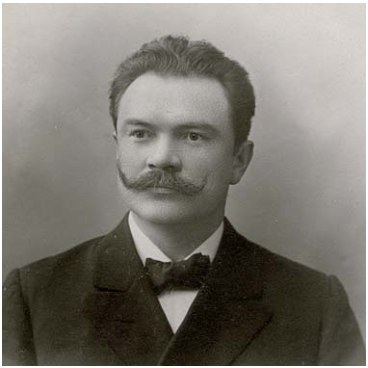
Pēteris Šmits
1869 – 1938
- Kapsēta
- Forest Cemetery / Meža kapi, Riga, Latvia
Pēteris Šmits brought together two fields that might at first seem far apart: the study of Asian languages and the documentation of Latvian folklore. His research and teaching took him to the Russian Far East, where he worked with Chinese, Manchu and other languages. After returning to Latvia, he contributed to university scholarship and to the publication of extensive collections of tales, legends and beliefs. His comparative interests placed Latvian material within a wider enquiry into language and culture. The work depended on collecting and editing as well as interpretation, leaving resources that could be used by later generations. His international career also illustrates the importance of migration and scholarly exchange in the development of Latvian academic life. He died in Riga in 1938. Born in Rauna parish on 25 December 1869, Šmits completed gymnasium in Riga before studying Slavic languages at Moscow University in 1891–1892. He then transferred his attention to Chinese and Manchu at the University of St Petersburg, graduating from its Oriental languages faculty in 1896. A three-year research assignment took him to the Far East, where he investigated local communities and their customs. Employment with the Russian Ministry of Foreign Affairs subsequently brought him to Peking. In 1898 he taught Russian at the university there. [2] In 1899 Šmits moved to Vladivostok, becoming a professor and director at the newly established Far East Institute. His work on Mandarin grammar earned him a master’s degree from St Petersburg University in 1902. That year he also published a Chinese reader, followed in 1907 by a Manchu textbook. Between 1907 and 1912 he made regular research visits to Mongolia. His career in the region extended across the Russo-Japanese War and the First World War. When the Vladivostok institute became the Far East State University in 1918, he took office as dean of its philology and philosophy faculty. [2] His linguistic investigations extended beyond the languages used in his principal teaching texts. He visited numerous Manchu and Tungus communities, documented their languages and examined their folklore and beliefs. He classified the Tungus-Manchu languages as a separate group and produced vocabularies and grammars for several of them. Later publications through the University of Latvia included studies of Negidal and Olcha in 1923, Oroch in 1927 and Samagir in 1928. A paper on sound changes in Manchu and Mongolian had appeared in 1898; another, examining Chinese elements in Manchu, followed in 1932. [2] Throughout his years abroad, Šmits maintained connections with Latvia, and Latvian remained the language spoken in his household. During the Russian Civil War, when Latvian riflemen served on opposing sides, he helped organise the consolidation of riflemen into the Imanta Regiment in Vladivostok. He travelled back to Latvia by ship with that regiment in 1920. He then participated in establishing the University of Latvia, held a professorship in its Faculty of Philology and Philosophy, and chaired the Society of Philologists. These responsibilities placed his experience of Asian languages within the institutional development of scholarship in Latvia. [2] During the 1920s, his summers included journeys around Latvia to record legends, beliefs, tales, sayings and other forms of oral tradition. His fifteen-volume Latvian Fairy-Tales and Legends appeared between 1925 and 1937. For this collection he prepared an introductory study of about 130 pages, which the linguist Jānis Endzelīns considered substantial enough to merit comparison with a dissertation. Šmits drew on knowledge of other peoples’ traditions in his interpretation of Latvian material. Latvian Beliefs, issued in four volumes in 1940–1941 after his death, joined the earlier collection as a foundation for subsequent research into Latvian narrative folklore. [2] His later public responsibilities included reorganising the Riga Latvian Society’s Science Commission into a Science Committee in 1932. He directed the society’s Academia Scientiarium Latviensis, identified as a predecessor of the Latvian Academy of Sciences, and was an honorary member of the society itself. Uppsala University awarded him an honorary doctorate in 1927, followed by the University of Latvia in 1928. He received the Fatherland Prize in 1938. His university professorship continued until his death on 5 June that year, and he was buried in Meža kapi, Riga’s Forest Cemetery. [2]
Grāmatu “100 Latvijas personību”, kurā iekļauta arī šī personība, var iegādāties šeit.
The map marker shows the cemetery; the exact grave position is not yet established.
Sources & Further Reading
Books
- [2] Apinis, P. A Hundred Great Latvians. Nacionālais apgāds, Riga, 2006, pp. 62-63. ISBN 9984-26-288-X.
Web resources
- [1] Pēteris Šmits