
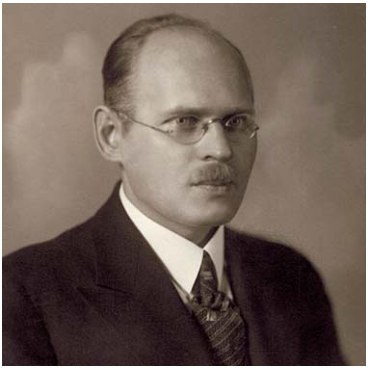
Pauls Stradiņš
1896 – 1958
- Kapsēta
- Forest Cemetery / Meža kapi, Riga, Latvia
Pauls Stradiņš combined surgery, teaching and the organisation of medical services with a deep interest in the history of medicine. His collection of objects and documents became the foundation of the museum in Riga that bears his name. His career involved study and professional exchange abroad before extensive work in Latvia. He helped develop clinical institutions and training, including attention to cancer care and nursing. The breadth of his activity makes him significant beyond any one medical procedure or research paper. Preserving the history of medicine was part of his understanding of the profession itself: practitioners could learn from both achievements and mistakes of earlier generations. He died in 1958 and was buried in Riga. Born in Viesīte on 17 January 1896, Stradiņš studied at the Petrograd Academy of Military Medicine from 1914 to 1919. His teachers included Sergei Fyodorov, surgeon to Emperor Nicholas II, and the physiologist Ivan Pavlov. Under Pavlov’s supervision he prepared his first doctoral dissertation, examining injuries to peripheral nerves. This research included extensive study of operations performed by the French surgeon René Lériche. Stradiņš also underwent an operation on his own brachial artery for research purposes, an unusual episode in his early medical investigations. [2] On returning to Latvia in 1923, he began work in the University of Latvia’s Faculty of Medicine. A Rockefeller fellowship enabled him to work at the Mayo Clinic in Rochester, United States, in 1925–1926, followed by work in London. During this period he developed a second doctoral thesis, devoted to spontaneous gangrene. In 1928 he was elected to lead the university’s Department of General Surgery, and in 1933 he became a professor. His scientific output eventually exceeded eighty works, published in specialist journals in Latvian, Russian, German, English, Polish, Finnish, Lithuanian and Armenian. [2] Between 1931 and 1947, apart from an interruption during the German occupation, Stradiņš was head doctor of Riga City Hospital No. 2; from 1944 he also served as its director. Under his leadership, the hospital introduced treatment methods and addressed both research questions and practical problems in surgery. Its work encompassed oncology, transfusion, cardiovascular surgery, anaesthesiology, rheumatology and chemotherapy. He trained younger surgeons in abdominal, pulmonary and goitre operations and encouraged them to acquire new techniques. He also helped develop oncological diagnosis and surgery during the years when many other leading Latvian surgeons had left the country. [2] Cancer care occupied a substantial part of his organisational work. During 1932–1938 he organised a clinic, a hospital and a society devoted to combating cancer. He began a register of cancer cases in Latvia and investigated the relief of pain in patients whose disease could not be cured. From 1937 to 1940 he headed the Health Promotion Society, which he had organised. In 1939 he established Latvia’s first cancer-treatment hospital and a nursing school. Two years later he founded the State Blood Transfusion Station, adding another institution to the country’s medical services. [2] The military and political changes of 1944 placed heavy demands on his hospital and university work. As German forces withdrew and the Red Army advanced, numerous doctors and medical teachers fled westwards. Stradiņš had opportunities to leave but remained, performing operations under a heavy workload and at times serving as the hospital’s only surgeon. The medical faculty continued functioning after the Soviet Union reoccupied Latvia, and he taught across surgical specialities and additional subjects. Soviet authorities subsequently condemned his activities as bourgeois and nationalistic, removed him as head doctor and subjected him to public humiliation. He also served as medical faculty dean and directed the Academy of Sciences’ Institute of Biology and Experimental Medicine from 1946 to 1951. [2] The historical collection he assembled with his own resources had beginnings in the hospital cellars around 1930. It provided the basis for a medical-history museum in 1944, which received independent state status in 1957. Following his death on 14 August 1958, his name became associated with the clinical university hospital, the Riga museum and the Health and Social Care College in Jūrmala. Annual conferences commemorate his work. The Latvian Academy of Sciences and the museum also jointly award two annual Stradiņš prizes recognising contributions to medical science and medical history. His burial place is Meža kapi, Riga’s Forest Cemetery. [2]
Grāmatu “100 Latvijas personību”, kurā iekļauta arī šī personība, var iegādāties šeit.
The map marker shows the cemetery; the exact grave position is not yet established.
Sources & Further Reading
Books
- [2] Apinis, P. A Hundred Great Latvians. Nacionālais apgāds, Riga, 2006, pp. 108-109. ISBN 9984-26-288-X.