
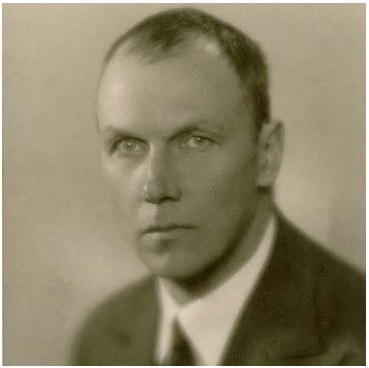
Pauls Kundziņš
1888 – 1983
- Kapsēta
- Skogskyrkogården / Woodland Cemetery, Stockholm, Sweden; ashes interred there according to the book
Pauls Kundziņš helped establish the study and preservation of Latvia’s vernacular buildings as a serious cultural undertaking. His work with the Latvian Ethnographic Open-Air Museum brought farm buildings and other structures into a setting where their construction and use could be understood together. He also taught architecture and researched rural building traditions. This attention to ordinary structures widened the idea of architectural heritage beyond palaces and civic monuments. After the Second World War he worked in exile, contributing to educational and professional networks before settling in Canada. He died in Halifax in 1983. Born in Smiltene on 4 February 1888, Kundziņš was the second of five children. His father, Kārlis, was the town’s Lutheran parish priest and took an active interest in his sons’ education. Pauls attended Tartu Classical Gymnasium before studying architecture at Riga Polytechnical Institute. On graduating in 1913, he received the Augusts Reinbergs Prize. He had already participated in exhibitions of Latvian artists in Riga in 1909 and 1913. During the First World War he was called into the Russian army, returning to Latvia in 1918. [2] His university career began in 1919, when he helped organise the University of Latvia’s architecture faculty and joined its teaching staff. He headed the Architecture Workshop, delivered lectures and organised the gathering of material about Latvian buildings. In 1933 he defended a doctoral thesis on Latvia’s residential threshing-barns and was elected professor. His preservation activities had developed alongside this academic work: an article published in 1918 began a sequence of publications and public initiatives concerning old rural farmsteads. From 1923 he worked with the Board for Monuments on standards and legislation for protecting architectural heritage. [2] His architectural practice encompassed community buildings, housing, churches and temporary festival structures. Projects included community houses at Ainaži and Jaunpils, homes for railway workers in Gulbene, apartment buildings in Riga and private residences in Mežaparks. His churches at Allaži and Ikšķile employed features associated with a Latvian architectural style. He also designed memorials to soldiers of the War of Liberation in Limbaži, Cēsis and Mazsalaca. Festival commissions included removable structures for the first Latvian Youth Festival and the sixth All-Latvian Song Festival in 1926. A house completed at 2 Mārupes Street in 1931 represented functionalism, while his furniture design received the Grand Prix at the 1937 Paris international exposition. [2] The museum project proceeded through several stages after he proposed it in 1924. In 1927 Riga allocated seventy hectares beside Lake Jugla, following a request from Education Minister Rainis. The Rizgas threshing house became the first historic building erected on the site in 1928. The grounds were arranged into areas corresponding to Vidzeme, Kurzeme, Latgale and Zemgale. When the museum opened in May 1932, six buildings formed its representation of a Vidzeme farmstead. By 1939 the collection had grown to forty buildings representing all four regions. Its preservation programme included surroundings, interiors, tools and everyday objects, rather than buildings alone. [2] Kundziņš also worked through national organisations concerned with construction and commemoration. He contributed to the National Building Committee and the Foundation of Monumental Buildings, chaired the Chamber of Professions and belonged to the Riga Latvian Society and the War Cemetery Committee. In preservation debates, he gave particular attention to rural construction and country churches. His assessment of architectural value considered proportions in relation to location, national characteristics and period. Recognition included the Krišjānis Barons Foundation Prize in 1933 and 1935, the Culture Foundation Prize in 1935, and the Order of the Three Stars in 1929 and 1935. [2] After leaving Latvia for Germany as a refugee in 1944, Kundziņš helped establish the Baltic University at Pinneberg and held leadership responsibilities in its architecture and engineering faculty. He organised Latvian architects’ societies across several countries and participated in Stockholm’s Institute for Folklife Studies. From 1952 he lived in Halifax, continuing architectural practice, theoretical writing and Latvian community activities. His publications numbered more than one hundred; among them was Latvju sēta, published in Stockholm in 1974, the year he received the Nation’s Award. His ashes were buried at Skogskyrkogården, Stockholm’s Woodland Cemetery. [2]
Grāmatu “100 Latvijas personību”, kurā iekļauta arī šī personība, var iegādāties šeit.
The map marker shows the cemetery; the exact grave position is not yet established.
Sources & Further Reading
Books
- [2] Apinis, P. A Hundred Great Latvians. Nacionālais apgāds, Riga, 2006, pp. 94-95. ISBN 9984-26-288-X.