
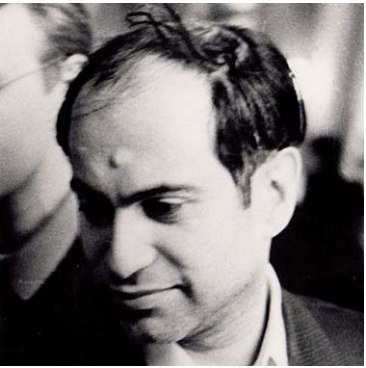
Mihails Tāls / Mikhail Tal
1936 – 1992
- Kapsēta
- Šmerlis Jewish Cemetery, Riga, Latvia
Mihails Tāls became world chess champion in 1960, defeating Mikhail Botvinnik. His reputation rested especially on imaginative attacking play: positions that appeared secure could become complicated through an unexpected sacrifice or a sudden change of direction. Born and raised in Riga, he brought an individual style to the highly competitive world of Soviet chess. Although his championship reign was brief, he remained a formidable player and an influential writer and commentator. His games invited audiences to see chess as a contest of imagination as well as calculation. The fascination they continue to generate is central to his legacy. He died in 1992 and was buried in Riga's Šmerlis Jewish Cemetery. His earliest instruction came from his father, Nekhemia Tal, a doctor, who taught him chess at seven. Organised training followed at the Riga Pioneers’ Palace with Jānis Krūzkops. Aleksandr Koblenz subsequently became his coach and accompanied his development through major competitions. Accounts of Tal’s childhood include extraordinary achievements in reading and mental arithmetic, although the chapter presents these stories as part of the legends surrounding him. His later education had a firm literary foundation: in 1958 he completed his studies in the University of Latvia’s Faculty of Philology. [2] The route to international competition passed through Latvian and Soviet championships. In 1956 Tal shared second and third place with Aivars Ģipslis in the Latvian SSR Championship and attained the title of master. The following year he won the USSR Championship with fourteen points from twenty-one games, a success accompanied by his elevation to grandmaster. Victory in the 1959 Candidates Tournament in Yugoslavia secured his opportunity to contest the world title. These results placed him at the forefront of Soviet chess within a short period after his emergence in republican competition. [2] The championship match ran from 15 March to 7 May 1960 and ended with a score of 12½–8½. When Tal’s train reached Riga on 10 May, thousands gathered to welcome him. The return match took place between 15 March and 12 May 1961, during a worsening of his kidney disease, and ended 13–8 in Botvinnik’s favour. Tal remained a contender: in the 1965 candidates competition he defeated Lajos Portisch and Bent Larsen before losing the final to Boris Spassky. His pursuit of the championship therefore extended beyond the two matches that had first brought him the title and then cost him its possession. [2] Alongside tournament play, Tal sustained a substantial editorial career. From 1960 until 1970 he was editor-in-chief of Šahs, a chess periodical issued in Latvian and Russian. His work and that of Ģipslis helped the magazine gain an international readership. He supplied tournament reports to news agencies and specialist journals, combining detailed knowledge with concise, witty commentary. His books included The Botvinnik–Tal Match, published in 1960, Into the Fire of Attack in 1978, and When the Pieces Turn Alive in 1983. These publications gave readers access to his explanations as well as his competitive performances. [2] Public appearances took him far beyond conventional tournament rooms. He lectured and gave simultaneous exhibitions in community buildings, sports venues, coal mines and aboard a ship. For the Kiev Film Studio’s Seven Steps behind the Horizon, a film concerned with the capacities of the human brain, he played ten games simultaneously without seeing the boards and scored 7–3. The chapter also records his willingness to teach children, describing friendly encounters in which he introduced young people to the fundamentals of chess. [2] A major late achievement came in 1988 at the inaugural World Blitz Championship in Canada. With leading players including Anatoly Karpov and Garry Kasparov taking part, Tal reached the final and defeated Rafael Vaganian 3½–½. He thus became the first holder of that championship. Together with his long editorial service and numerous exhibitions, this result documents the breadth of a career that continued to produce significant achievements decades after his first successes in Soviet competition. [2]
Grāmatu “100 Latvijas personību”, kurā iekļauta arī šī personība, var iegādāties šeit.
The map marker shows the cemetery; the exact grave position is not yet established.
Sources & Further Reading
Books
- [2] Apinis, P. A Hundred Great Latvians. Nacionālais apgāds, Riga, 2006, pp. 172-173. ISBN 9984-26-288-X.