
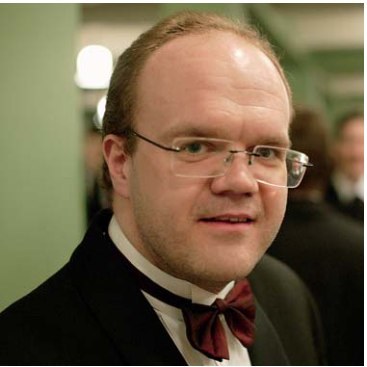
Māris Sirmais
1969 –
Māris Sirmais helped bring Latvian choral performance to international audiences through conducting, teaching and ensemble leadership. He founded the youth choir Kamēr... in 1990 and became closely associated with the State Choir Latvija. His work combines the preparation of demanding repertoire with the development of singers and collaborations with composers. Concerts, competitions and recordings have provided different settings for that activity. His career belongs to Latvia's long choral tradition while also demonstrating how that tradition continues to change through new music and ambitious performance. The contribution is both artistic and educational: a conductor shapes individual interpretations while helping a community of singers develop over time. Born in Riga on 27 June 1969, Sirmais studied singing at the Emīls Dārziņš Music School. His early experience was not confined to lessons: he appeared at the Latvian National Opera in Benjamin Britten’s children’s opera The Little Sweep. He subsequently studied choral conducting at the Latvian Academy of Music. While in his third year, he successfully participated in the first International Conducting Competition in Tallinn. In 1996 he completed a master’s degree in Professor Imants Kokars’s conducting class, then continued with orchestral conducting studies at the University of Music and Dramatic Arts in Graz, Austria. [2] Practical experience with established choirs accompanied this education. As an accompanist to the male choir Dziedonis, directed by Kokars, he worked within an ensemble noted for its professional standard. From 1992 to 1997 he also worked with the women’s choir Dzintars, which had won numerous international competitions. His own youth ensemble began at Riga Gymnasium No. 1 while he was still a student. Kamēr… did not simply lose its members when they completed school: some continued singing, while new pupils entered, creating a group that could number as many as seventy. [2] With singers averaging between seventeen and twenty years of age, Kamēr… required continuing preparation through changes in membership. The chapter records more than sixty international competition prizes and, in 2006, three laureate distinctions at the fourth World Choir Games in China. A 2004 tour of northern Italy also included recognition through the European Grand Prix. Alongside such public achievements, Sirmais placed particular value on the quality of rehearsals and on sustaining his own engagement with the music. His account of successful work therefore gave importance to preparation as well as to competition results. [2] In 1997 he received Latvia’s Great Music Award for his contribution to choral culture and became artistic director and principal conductor of the State Academic Choir Latvija. Under his direction, that ensemble received the award in 1998, 2000 and 2002; Kamēr… was also honoured twice. As artistic director of Riga’s annual international sacred music festival, Sirmais encouraged Latvian composers to write new works and undertook their performance. His programmes gave a substantial place to Pēteris Vasks, Maija Einfelde, Arturs Maskats, Ēriks Ešenvalds and Andris Dzenītis alongside contemporary composers from other countries. [2] Large choral and orchestral scores formed another important part of this activity. Collaborations with the Liepāja Symphony Orchestra, the Latvian National Symphony Orchestra and the Riga Festival Orchestra encompassed Poulenc’s Gloria, Dvořák’s Requiem, Bruckner’s Te Deum and Stravinsky’s Symphony of Psalms. The repertoire also included music by Tavener, Górecki, Pärt and Kancheli, together with extensive unaccompanied programmes. On 17 June 2000, in the Swedish city of Umeå, Sirmais conducted Pärt’s Te Deum with the Umeå Symphony Orchestra at a festival organised by Botnia Musik, an engagement identified as his international conducting debut. [2] His responsibilities also reached the massed ensembles of Latvia’s song festivals. In 1998 he became the country’s youngest head conductor at both the All-Latvian Song Festival and the school youth festival. Abroad, Kamēr… carried Latvian repertoire into settings far removed from its school origins. At one performance in a French town square, an audience of about ten thousand stood and joined in during Pūt, vējiņi! Such occasions formed part of the documented public reach of his work, alongside the more specialised settings of competitions, sacred music festivals and major concert programmes. [2]
Grāmatu “100 Latvijas personību”, kurā iekļauta arī šī personība, var iegādāties šeit.
Sources & Further Reading
Books
- [2] Apinis, P. A Hundred Great Latvians. Nacionālais apgāds, Riga, 2006, pp. 212-213. ISBN 9984-26-288-X.