
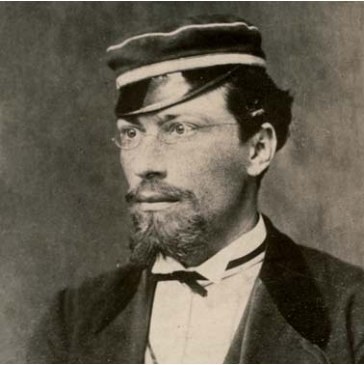
Kristaps Helmanis
1848 –
- Kapsēta
- Tērvete Cemetery, Latvia, as reported by the book
Kristaps Helmanis belonged to the generation that helped establish laboratory methods for studying infectious disease. Trained in veterinary medicine at Dorpat, he worked in St Petersburg on diseases affecting animals and on approaches to vaccination and diagnosis. His research connected Latvian scientific experience with international developments in microbiology. Helmanis is associated with work on mallein and tuberculin, substances important in the investigation of glanders and tuberculosis. He also corresponded with Louis Pasteur and participated in the early institutional development of experimental medicine. This was hazardous work, undertaken before modern laboratory safeguards. Helmanis was born on 3 June 1848 in Tērvete, then known as Kalnamuiža. He attended the parish school and the science-oriented secondary school in Jelgava. To support his further studies, he spent eight years employed in breweries, where he also investigated fermentation. From 1873 to 1877 he studied at the Dorpat Veterinary Institute, concentrating particularly on microbiology. A student investigation of sperm development in vertebrates earned him a gold medal, but his financial circumstances obliged him to sell the award to meet ordinary living expenses. [2] After graduation he remained at the institute as an assistant and defended his dissertation in 1879. The salary was insufficient, however, and he moved to St Petersburg to take a better-paid appointment as veterinarian to a guards cavalry regiment. There he established a laboratory beside the dispensary and began examining glanders in horses and experimentally infected animals. Veterinary training offered an important route into science for Latvians at this time: unlike some other university courses, it did not impose the same preference for applicants from privileged social backgrounds. Latvian graduates subsequently became teachers and professors at Dorpat. [2] Glanders presented a serious diagnostic problem because chronically infected horses could spread the disease without showing clear clinical signs. Helmanis obtained an extract of the causative bacilli, called mallein. When injected into affected animals, it produced fever and swelling at the injection site, reactions not observed in healthy animals. In 1891 he and Oto Kalniņš demonstrated its diagnostic value. The research also brought fatal infections among their colleagues: Alfrēds Bertušs and Roberts Vāgners died in 1890, and Kalniņš in 1891. Their deaths formed part of the immediate human cost of investigating a disease dangerous to people as well as horses. [2] Another strand of his work concerned rabies, which he began investigating in connection with vaccine development in 1883. He reported his findings to Prince Alexander Petrovich of Oldenburg, who supported the research. In 1886 Pasteur sent two collaborators to St Petersburg to help establish a treatment centre, and Helmanis also travelled to Paris. The resulting institution was the first Pasteur station outside Paris. Under Helmanis’s direction it vaccinated people who had been bitten, while its research extended to syphilis, smallpox and anthrax. His rabies studies examined the illness’s course, its spread within the body and possible treatment. [2] In 1889 Helmanis developed a method for growing tuberculosis bacilli on potato using glycerine solution and blood serum. His subsequent experiments yielded tuberculin independently of Robert Koch’s work. He communicated the finding to Pasteur and continued investigating, while Koch published his own results. In 1890 Helmanis left military service and, with Oldenburg’s support, founded the Institute of Experimental Medicine, where he directed epizootology. His public recognition included hereditary nobility and the Orders of St Stanislav, Third Class, and St Vladimir, Fourth Class. These distinctions accompanied his movement from regimental veterinary work into the leadership of a research institution. [2] On 10 March 1892 Helmanis married Emmelin Strandman, an Estonian singer. He died later that year in St Petersburg, aged forty-four, and was buried in Tērvete Cemetery. His career belonged to a wider circle of Latvian veterinary researchers that included Eižens Zemmers as well as the colleagues lost during the glanders experiments. Together, their work encompassed infectious disease diagnosis, vaccination and treatment. Helmanis’s particular contribution is documented through the diagnostic use of mallein, his independent tuberculin experiments and the St Petersburg institutions in which laboratory research and treatment were brought together. [2]
Grāmatu “100 Latvijas personību”, kurā iekļauta arī šī personība, var iegādāties šeit.
The map marker shows the cemetery; the exact grave position is not yet established.
Sources & Further Reading
Books
- [2] Apinis, P. A Hundred Great Latvians. Nacionālais apgāds, Riga, 2006, pp. 30-31. ISBN 9984-26-288-X.