
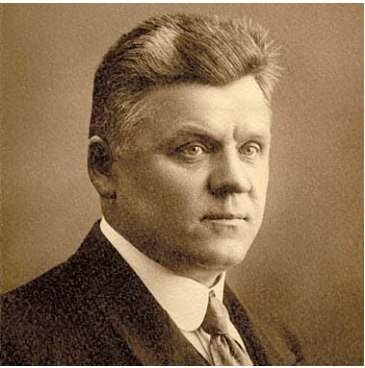
Kārlis Ulmanis
1877 – 1942
- Kapsēta
- Reported burial in Krasnovodsk, now Türkmenbaşy, Turkmenistan; exact grave unknown
Kārlis Ulmanis was a central figure in the founding of the Republic of Latvia and served repeatedly as prime minister. His background in agricultural education and his experience abroad informed an interest in economic development and rural life. His record also includes the coup of 15 May 1934, which ended parliamentary democracy and established authoritarian rule. Soviet occupation in 1940 removed him from power and led to detention. He died in a prison hospital in Krasnovodsk in 1942. Although accounts place his burial there, the exact grave has not been established. Born at the Pikšas farmstead near Jelgava on 4 September 1877, Ulmanis completed his studies at the Jelgava Realschule in 1896 and took dairying courses in East Prussia the following year. He began agricultural studies at ETH Zurich in autumn 1902 before attending Leipzig University between 1903 and 1905. Back in Latvia in summer 1905, he worked for the Kauguri Agricultural Society as an instructor in dairying and cattle breeding. He also assumed the practical editorial direction of Lauksaimnieks, a periodical devoted to farming. [2] Arrested on 21 December 1905 for involvement in the revolution, he spent a short period in prison in Pskov. After his release in 1906, he travelled through Finland and Sweden to Germany, then went to the United States in 1907. There he pursued agricultural studies in Lincoln, Nebraska, and owned a dairy farm in Texas. He returned to Latvia in 1913. His subsequent work included employment as an agronomist with the Baltic Agricultural Society in Valmiera, authorship of agricultural books and the editorship of Zeme from 1914 to 1916. [2] The political changes of 1917 brought him into regional administration. Following the February Revolution in Russia, he was elected to the provisional council for Vidzeme, which appointed him deputy temporary commissar of the province. He initiated and chaired the Latvian Agrarian Union, organising supporters of an independent Latvia and seeking international support for establishing the state. In 1918 he participated in the Democratic Bloc and helped organise the Latvian National Council. Following the proclamation of the republic on 18 November, the council unanimously selected him to lead its provisional government. [2] During the parliamentary period, Ulmanis sat in the Constituent Assembly of 1920–1922 and in all four elected Saeimas, representing the Agrarian Union. He led its parliamentary faction and worked in several commissions. His ministerial responsibilities at different times included foreign affairs, agriculture, supply and war. Alongside politics, he held senior posts at the Latvian Farmers’ Bank and served on the board of the State Land Bank. He continued publishing on agricultural and political subjects, editing Baltijas Lauksaimnieks in 1918 and the Brīvā Zeme supplement Zemes Spēks between 1921 and 1938. [2] The institutional consequences of his seizure of power in May 1934 included the dissolution of the fourth Saeima and the prohibition of every political party. In April 1936, after Alberts Kviesis’s presidential term ended, Ulmanis also assumed the presidency, combining it with leadership of the government. The chapter associates this period with expanding production and exports, lower unemployment, higher wages, and reforms in education and health care. It also records the favourable recollection of these economic conditions among Latvians. These developments occurred within the authoritarian political system established after parliament and organised party competition had been removed. [2] The Soviet occupation began on 17 June 1940. Three days later Ulmanis was compelled to approve an administration headed by Augusts Kirhenšteins, ending his tenure as prime minister, although he formally remained president until 21 July. On 22 July the Soviet internal affairs authorities deported him to Voroshilovsk in Russia. After Germany began its war against the Soviet Union, he was transferred to Krasnovodsk, in present-day Turkmenistan. The chapter’s account of his burial rests on witness testimony rather than an identified grave, leaving the precise location of his remains unresolved. [2]
Grāmatu “100 Latvijas personību”, kurā iekļauta arī šī personība, var iegādāties šeit.
The map marker shows the cemetery; the exact grave position is not yet established.
Sources & Further Reading
Books
- [2] Apinis, P. A Hundred Great Latvians. Nacionālais apgāds, Riga, 2006, pp. 76-77. ISBN 9984-26-288-X.