
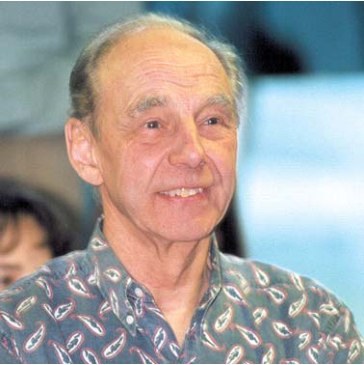
Juris Hartmanis
1928 – 2022
- Kapsēta
- Burial location not verified; Cornell’s memorial account is not a cemetery record
Juris Hartmanis helped establish computational complexity as a field concerned with the resources required to solve problems. Work with Richard Stearns provided foundations for comparing computations according to limits such as time. They received the ACM Turing Award in 1993. Born in Riga and displaced by war, Hartmanis continued his education abroad and built his career in the United States. As the founding chair of Cornell’s computer science department, he helped create an institutional home for a discipline still defining itself. His legacy combines theoretical results with the development of teaching and research communities. The upheavals of Hartmanis’s childhood included the destruction of his father’s military career and life. Mārtiņš Hartmanis served on the headquarters staff of the Latvian Army and held the Lāčplēsis Military Order. Soviet authorities arrested and deported him on 20 December 1940; he was executed in Moscow on 27 July 1941. In Germany, Juris attended the Latvian secondary school at Hanau and subsequently studied physics at Marburg University. His later studies concentrated on mathematics: he received a master’s degree from the University of Kansas City in 1951 and completed his doctorate at the California Institute of Technology in 1955. [2] His early professional appointments included lecturing at Cornell and Ohio State. In 1958 he moved into industrial research at the General Electric Research Laboratories, where his work involved both developing and putting into practice principles of computer science. This laboratory period provided the setting for research with colleagues that led to his 1965 publication on the fundamental principles of computational complexity. His career at this stage therefore crossed between university teaching and a research organization concerned with the scientific foundations and practical development of computing. [2] Returning to Cornell in 1965, Hartmanis combined research with sustained departmental leadership. His periods as head of computer science extended from 1965 to 1971, from 1977 to 1982, and again from 1992 to 1993. These were separate terms across nearly three decades, rather than a single founding appointment. The department became one of the leading university centers for computer science in the United States. His educational activity also had an international reach: he supervised doctoral researchers from twenty countries, welcomed scientists from Latvia for further training, and gave guest lectures on five continents. [2] Questions about the future direction of the discipline occupied him beyond the boundaries of his own research. Between 1990 and 1992 he led the study published as “Computing the Future: A Broader Agenda for Computer Science and Engineering.” It encouraged computer scientists to consider work outside their particular specialties. From 1996 to 1998 he directed the National Science Foundation’s Directorate for Computer and Information Science and Engineering. This federal appointment added responsibility for a wider scientific program to his experience in industrial research and university administration. [2] Hartmanis’s published output exceeded one hundred scientific works and included four monographs. He was also associated with the publication of the “Lecture Notes in Computer Science” series. His editorial responsibilities extended to specialist journals and numerous scientific editorial boards, while his complexity-theory columns appeared in SIGACT News and the Bulletin of the European Association of Theoretical Computer Science. Alongside his own papers and books, these activities formed a continuing contribution to the circulation and discussion of research within the international theoretical computer science community. [2] Recognition came from scientific institutions in several countries. He entered the United States National Academy of Engineering in 1989 and became a foreign member of the Latvian Academy of Sciences in 1990. In 1995 he received both the Czech Academy of Sciences’ Bolzano Gold Medal and an honorary doctorate from Dortmund University; the University of Missouri awarded him another honorary doctorate in 1999. Latvia’s Academy of Sciences presented its Grand Medal to him in 2001. These distinctions accompanied a career whose documented reach included research publications, doctoral supervision, editorial work, and leadership of academic and national scientific institutions. [2]
Grāmatu “100 Latvijas personību”, kurā iekļauta arī šī personība, var iegādāties šeit.
The resting place has not yet been established.
Sources & Further Reading
Books
- [2] Apinis, P. A Hundred Great Latvians. Nacionālais apgāds, Riga, 2006, pp. 146-147. ISBN 9984-26-288-X.
Web resources
- [1] Juris Hartmanis