
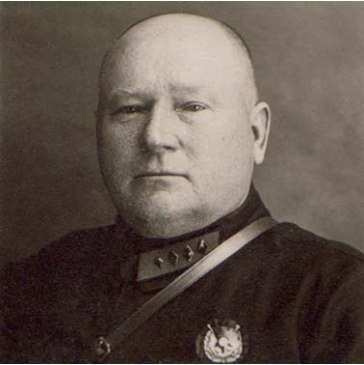
Jukums Vācietis
1873 – 1938
- Kapsēta
- Book reports a mass burial at Kommunarka, Moscow region
Jukums Vācietis rose from the Imperial Russian Army and the Latvian riflemen to command major forces during the Russian Civil War. In 1918 he became the first commander-in-chief of Soviet Russia’s armed forces. His career illustrates the difficult and divergent political choices made by Latvian officers during revolution and war. He later worked in military education, but high rank did not protect him from Stalin’s purges. He was arrested and executed in 1938. Vācietis was born in Kuldīga District on 23 November 1873 and completed Kuldīga Ministry School in 1891. After graduating from Vilnius Military College in 1902, he served with the Riga Battalion of Non-commissioned Officers. In 1904 he married Margarethe Kaerger, a Baltic German; they had three children. His professional training continued at the Nicholas General Staff Academy in St Petersburg, which he entered in 1906 and completed three years later. These successive stages of education preceded the wartime commands through which he became widely known. [2] In 1914 he commanded the 102nd Vyatka Infantry Regiment in fighting against German forces and sustained wounds and a contusion. In November 1915 he was assigned command of the Fifth Latvian Zemgale Rifle Battalion, subsequently expanded into a regiment. The riflemen later remembered his readiness to speak with ordinary soldiers and instruct them directly. Before the difficult fighting of July 1916, he addressed them in a church at Piņķi, near Riga. Their recollections also associated him with an orderly military life and a concern for the men under his command. [2] Cultural activity had a place within his unit. Vācietis enjoyed literature and theatre, and supported the riflemen’s newspapers and theatrical work. The poet Edvards Virza was associated with the battalion as its poet. Soldiers knew their commander by the nickname Vecais, meaning “the Old One.” Photographs preserved in the chapter show him among riflemen between engagements, with the battalion band, and celebrating Midsummer near Valka in 1917. These records document contacts with the soldiers outside formal command duties, alongside his presence close to the battlefront. [2] His appointments followed one another rapidly after the October upheaval of 1917. In November he became commander of the Twelfth Army; the following month, as chief of the Revolutionary Field Headquarters, he began organising Red Guards. Command of the Latvian Soviet Rifle Division followed in April 1918. During that year, riflemen under his authority guarded Lenin, and Vācietis directed the suppression of the Socialist-Revolutionary rebellion from Lenin’s office. Lenin recommended him for the supreme military appointment that took effect on 6 September. Although he collaborated with Bolshevik authorities, Vācietis never joined the Communist Party or any other political party. [2] In July 1919 the Cheka arrested him on an allegation of involvement in a counter-revolutionary White Guard organisation. The accusation proved unfounded, and after his release he received an assignment to the Revolutionary Military Council. He began teaching at the Red Army Military Academy in 1920 and later held a professorship there. In the early 1920s he wished to return to Latvia, but only his family returned. His book The Historical Significance of Latvian Riflemen argued that the Bolshevik victory had created an opportunity for Latvian independence, presenting that interpretation as an explanation for the riflemen’s defence of Soviet power. [2] His final arrest occurred on 29 November 1937 during an interval between lectures. The authorities alleged that he belonged to a Latvian fascist organisation within the Red Army. His case formed part of the wider repression of Latvians in the Soviet Union, which also killed other senior officers of Latvian origin. On 26 July 1938 Stalin and Molotov approved a list of 138 people for execution that included Vācietis. He was shot on 28 July and buried in a communal grave at Kommunarka in the Moscow region. [2]
Grāmatu “100 Latvijas personību”, kurā iekļauta arī šī personība, var iegādāties šeit.
The map marker shows the cemetery; the exact grave position is not yet established.
Sources & Further Reading
Books
- [2] Apinis, P. A Hundred Great Latvians. Nacionālais apgāds, Riga, 2006, pp. 68-69. ISBN 9984-26-288-X.