
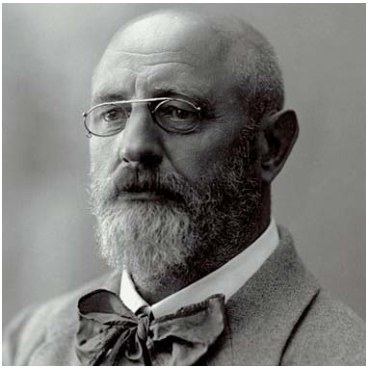
Jāzeps Vītols
1863 – 1948
- Kapsēta
- Forest Cemetery / Meža kapi, Riga, Latvia; reburied from Lübeck in 1993
Jāzeps Vītols helped establish the institutions through which Latvian musicians could receive advanced professional training at home. After a long period of study and teaching in St Petersburg, he returned to Latvia and founded its conservatory in 1919. His compositions, especially choral music, became important parts of the national repertoire. As a teacher, critic and organiser he influenced musical life beyond his own scores, helping to form the next generation of composers and performers. The academy that developed from the conservatory bears his name. Vītols left Latvia during the Second World War and died in Lübeck in 1948. Born in Valmiera on 26 July 1863, Vītols received his early education in Jelgava, completing a school with an emphasis on science in 1880. Music already occupied an important place in his youth: his earliest surviving manuscript, the short piano piece Andantino in A-flat major, dates from 1878. At seventeen he entered the viola class at the St Petersburg Conservatory. A year later he moved into Nikolai Rimsky-Korsakov’s specialist composition class, eventually completing his studies with honours and receiving a gold medal. [2] His subsequent teaching career at the same conservatory lasted more than thirty years. In 1908 he took charge of its specialist composition class, and in 1911 he was elected professor. Alongside this academic work, he maintained close connections with Latvian public musical life. Beginning in 1888, he participated in organising the All-Latvian Song Festivals and served as a chief conductor. His Symphony was first performed in Riga during the third festival that year. From that festival onward, his choral works appeared in every All-Latvian Song Festival programme, linking his professional career to a recurring national musical institution. [2] The breadth of his catalogue extended well beyond the concert choir. The chapter records 845 compositions, ranging from substantial works to miniatures, and notes that previously unknown pieces, particularly small vocal works, have continued to be found. His instrumental output included a Piano Sonata from 1886, the symphonic sketch Līgo from 1889 and the Dramatic Overture from 1895. Later orchestral works included Sprīdītis, completed in 1907, and the ballad The Song of Autumn from 1928. The suites Seven Latvian Folk Songs and The Serenade of the Latvian Countryside appeared in 1904 and 1934 respectively. [2] Folk-song arrangement remained a sustained part of his work, accounting for approximately three hundred settings. His vocal output also included ninety-two solo songs and 103 unaccompanied choral ballads, most of the latter intended for mixed voices. Among the named examples are The Singer of Beverīna, The Castle of Light and The King’s Daughter. For piano he wrote waltzes, études, preludes and mazurkas, as well as the nine-piece Variations on the Theme “Let the Sun Set!” and The Song of the Waves. He also composed for organ, cello and violin, while the orchestral suite Precious Stones became another well-known work. [2] The government appointed Vītols rector on 20 August 1919. His tenure continued until 1935 and resumed from 1937 to 1944; he also directed the composition class. The institution followed the classical conservatory model familiar to him from St Petersburg. He recruited distinguished musicians representing different national schools, bringing varied professional traditions into Latvian higher musical education. His organisational activity also included establishing the Group of Latvian Composers, whose membership initially consisted of composers but subsequently expanded to include performers. In 1937 he received the Fatherland Prize. [2] His later writings included the memoir Reminiscences of My Life. Following his death on 24 April 1948, he was initially buried in Lübeck. On 27 June 1993 his remains were reinterred in Riga’s Meža kapi. This return added a Latvian burial place to a legacy already preserved through performances, teaching and the institutions with which he had worked. His grave in Riga thus became part of the commemorative record of a career whose documented activities encompassed composition, musical education, criticism and public organisation. [2]
Grāmatu “100 Latvijas personību”, kurā iekļauta arī šī personība, var iegādāties šeit.
The map marker shows the cemetery; the exact grave position is not yet established.
Sources & Further Reading
Books
- [2] Apinis, P. A Hundred Great Latvians. Nacionālais apgāds, Riga, 2006, pp. 54-55. ISBN 9984-26-288-X.
Web resources
- [1] Jāzeps Vītols