
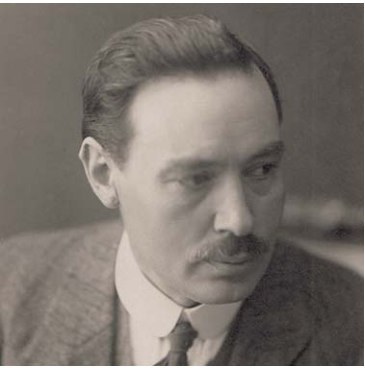
Janis Rozentāls
1866 –
- Kapsēta
- Forest Cemetery / Meža kapi, Riga, Latvia; reinterred from Finland in 1920
Janis Rozentāls helped establish a recognisably Latvian professional painting tradition while remaining receptive to artistic developments elsewhere in Europe. His work moved between portraits, scenes of everyday life and symbolic subjects, showing how national themes could coexist with international experimentation. He studied in St Petersburg and participated in the Latvian artists’ circle Rūķis. Travel and his connection with Finland, including marriage to the singer Elli Forssell, broadened his artistic environment. In Riga he contributed to a growing network of painters, writers and musicians. The First World War disrupted that world, and he died in Finland. His remains were returned to Riga in 1920. Rozentāls’ first practical training came through sign painting and lessons at the Riga German Crafts Society School. Born at the Bebri farmstead near Saldus on 18 March 1866, he gained recognition for his drawing before entering advanced study: a work submitted to an exhibition of art schools in St Petersburg received a silver medal in 1888. That year he entered the painting department of the Imperial Academy of Arts, where he remained until 1894. Portrait commissions from the city’s intellectual circles helped pay for his education, linking his training to a form of work that would remain central throughout his career. [2] His graduation painting, From Church, developed from sustained observation in the Saldus area. Over several summers he made studies of local residents and used both drawings and photographs to record people leaving Sunday worship. His parents appear at the centre of the finished composition. The decision to take a Latvian subject for this academic work arose during meetings of Rūķis. Completed in 1894, the painting earned him a first-class artist’s qualification. Two years later he helped organise the Latvian Ethnographic Exhibition in Riga and contributed paintings of everyday Latvian life. [2] Portraiture eventually accounted for more than three hundred works, including a substantial group depicting figures in Latvian cultural life. His practice also encompassed landscapes, scenes of daily life, symbolic compositions and religious paintings. The chapter identifies influences ranging from Kuindzhi and Serov to Munch, Edelfelt and German Symbolist painters. Rather than working in a single medium, he pursued graphic techniques, decorative commissions and monumental painting alongside easel pictures. His magazine designs for Vērotājs in 1903–1905 and the symbolic fresco on the Riga Latvian Society building in 1910 were important examples of his engagement with Art Nouveau. [2] His religious commissions included altarpieces for Riga’s New St Gertrude’s Church and churches in Dundaga and Stende, as well as work for the sacristy of St John’s Church in Riga. He also taught at V. Blum’s Art School and the Riga City Art School and maintained a private studio for teaching. Through press articles he addressed Latvian and foreign artists, exhibitions, aesthetic questions and the difficulties facing Latvian art. Exhibitions brought his own work before a growing audience, including a joint presentation with Bernhard Borchert in 1901, the Riga City Art Museum’s opening exhibition in 1905, and shows in Riga and Jelgava in 1910. [2] A distinct episode in his public life occurred in 1905, when he joined Rūdolfs Blaumanis, Arveds Bergs, Rainis and others in preparing a petition to the Tsar. Its demands concerned freedom of public discussion, restrictions on Latvian-language use, legal inequality and the election of a Constituent Assembly. The chapter describes this as his sole political intervention and connects official notice of it with his exclusion from election as an academician. His cultural associations were more continuous, including his friendship with Borchert, which began after he settled in Riga in autumn 1901. [2] Family life provided another working setting. Following his wedding in Helsinki on 5 March 1903, he spent several summers painting at the Forsell family home nearby. Latvian and Finnish were both spoken in the household, and he and Elli had three children: Laila, Irja and Miķelis. His later Finnish paintings employed strong contrasts of yellow, red and black and varied textures across portraits, landscapes and figure compositions. The 1916 portrait of M. Vīgnere-Grīnberga belongs among his last works. Exhibitions in Finland in 1920 and 1986 documented a continuing presentation of his art there after his lifetime. [2]
Grāmatu “100 Latvijas personību”, kurā iekļauta arī šī personība, var iegādāties šeit.
The map marker shows the cemetery; the exact grave position is not yet established.
Sources & Further Reading
Books
- [2] Apinis, P. A Hundred Great Latvians. Nacionālais apgāds, Riga, 2006, pp. 60-61. ISBN 9984-26-288-X.