
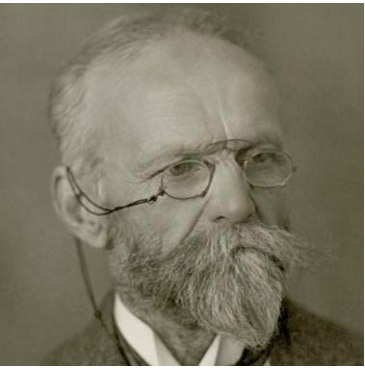
Jānis Misiņš
1862 – 1945
- Kapsēta
- Forest Cemetery / Meža kapi, Riga, Latvia
Jānis Misiņš approached collecting books as a means of preserving a people’s intellectual record. He sought publications in Latvian and material about Latvia and Latvians, including items that could easily disappear from ordinary circulation. What began as a personal undertaking developed into an enduring research resource. His library received permission to operate in 1885 and later moved to Riga. Through persistent collecting and bibliographic work, he made scattered publications easier to locate and study. He also contributed to the development of public library institutions after independence. His indexes gave later researchers a way to trace the history of Latvian printing and writing. The legacy is not only a collection of valuable books, but a method of remembering through accurate description, organisation and public access. Born on 25 April 1862 at the Krāces farmstead near Tirza in central Vidzeme, Misiņš acquired much of his education independently. An important stimulus came from Krišjānis Valdemārs, the Young Latvian publicist who had established a public library at Ēdole Church in 1848. Valdemārs’ 1880 article on libraries and national intellectual life encouraged Misiņš to begin his own undertaking. That year he started lending books once a week at Tirza School, initially without official authorisation. His first formally permitted collection at Krāces consisted of two hundred volumes. [2] The collection extended beyond bound books to manuscripts, photographs and small publications. Misiņš searched for both older material and recent printed works, purchased what he could and appealed for donations. His persistence met scepticism from contemporaries who regarded the undertaking as beyond the capacity of one person. The chapter also records less conventional methods: when ordinary routes failed, he might demand an item, borrow it or simply take it. His wife, Anna Jaunzeme, assisted him in the library’s work. Over approximately sixty years, he obtained almost every book that had been published in Latvian. [2] Travel gave him opportunities to examine library practice outside Latvia. He visited libraries in Russia, Finland, Germany and France before undertaking the establishment and management of the Latvian State Library and Latvia’s archives in 1919. As the State Library’s first head, he organised three departments. Lettica held printed material in Latvian, Baltica gathered literature concerning Latvia and Latvians, and a General Department accommodated the wider collection. These divisions gave the institution a framework for distinguishing language-based collecting from material defined by its subject. [2] The State Library’s early holdings were assembled amid the consequences of war and changes in ownership. In 1919 it received books from ownerless and nationalised libraries, as well as individual collections. Institutional acquisitions included the libraries of the Imperial Lyceum, Riga Religious Seminary and Alexander Gymnasium. Private collections belonging to the von der Pahlen, von Liewen and von der Borch families also entered its holdings. Misiņš subsequently served from 1920 to 1938 as deputy director of the Riga City Library, the institution historically known as Bibliotheca Rigensis, and headed its Latvian Books Department. [2] A separate agreement settled the future of his personal collection. On 7 December 1925, he transferred ownership of its 28,000 volumes to the City of Riga, with the condition that it bear the name Riga City Misiņš Library. At the library’s opening in Riga on 2 March 1928, he presented its inventory to the city’s head, Alfrēds Andersons, in the presence of librarian Kārlis Egle. The chapter identifies the resulting institution, within the Latvian Academic Library, as the oldest still-functioning collection of Latvian literature and records the continuing availability of its holdings to readers. [2] His scholarship included histories of printing, bibliographical indexes and exhibitions, among them a display marking the centenary of the Latvian press in 1922. His major two-volume Latviešu rakstniecības rādītājs covered general and scientific publications from 1585 to 1910, and fiction and works on art from 1585 to 1925. State recognition followed with awards of the Order of the Three Stars in 1926 and 1932. Misiņš died on 17 January 1945 and was buried in Riga’s Meža kapi, the Forest Cemetery. His surviving collection and bibliographical publications preserve complementary records of Latvian literary and publishing history. [2]
Grāmatu “100 Latvijas personību”, kurā iekļauta arī šī personība, var iegādāties šeit.
The map marker shows the cemetery; the exact grave position is not yet established.
Sources & Further Reading
Books
- [2] Apinis, P. A Hundred Great Latvians. Nacionālais apgāds, Riga, 2006, pp. 48-49. ISBN 9984-26-288-X.