
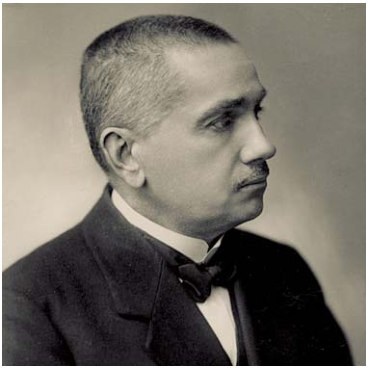
Jānis Endzelīns
1873 – 1961
- Kapsēta
- Rainis Cemetery / Raiņa kapi, Riga, Latvia
Jānis Endzelīns placed the study of Latvian within the wider history of Baltic and Indo-European languages. He investigated grammar, pronunciation and dialects, combining field material with rigorous comparison. His work helped explain the structures of Latvian rather than merely prescribe how it should be used. After working abroad, he returned to Latvia and taught at its university. He completed and expanded the dictionary begun by Kārlis Mīlenbahs, with further contributions from other scholars. This long collaboration produced a major reference work for readers and researchers. Endzelīns’ influence extends through both his own publications and the standards of evidence he brought to the study of language. Endzelīns’s academic preparation encompassed both classical and Slavic philology. Born in Valmiera District on 22 February 1873, he completed Riga Grammar School in 1892 and graduated from the two corresponding departments at Dorpat University in 1897 and 1900. While still a student, he published studies concerning Latvian vowel pronunciation and prepositions. His account of the language’s three intonations attracted specialist attention, and he was invited to lecture at Dorpat after graduating. In 1905 he defended a master’s dissertation on Latvian prepositions, developing a subject already present in his earliest research. [2] A move to Kharkov University in 1909 widened the range of his teaching. His courses included introductory linguistics and comparative accounts of Indo-European and Germanic grammar, alongside instruction in Lithuanian, Old Prussian, Armenian, Icelandic, Irish and Gothic. In St Petersburg in 1912 he defended a doctoral thesis examining relationships between the Slavic and Baltic languages. During these years he continued publishing articles and collecting Latvian dialect material. The combination of broad linguistic comparison and locally gathered evidence remained a documented feature of his work across different university appointments. [2] Several major publications addressed different needs within linguistic scholarship. His German-language grammar of Latvian, written in Kharkov, appeared in Latvia in 1922; an expanded Latvian edition followed in 1951. A reader published in German in 1922 provided scholars with an account of Latvian dialects. In the same year, the first part of his collection of Latvian place-names presented material from Vidzeme, chiefly farmstead names. A second part, issued in 1926, covered Kurzeme, Zemgale and Latgale. His later books treated Old Prussian in 1943, Baltic philology in 1945, and the sound systems and grammatical forms of Baltic languages in 1948. [2] Practical language development formed another substantial part of his activity. Between 1907 and 1910, Endzelīns and Kārlis Mīlenbahs developed a new Latvian orthography, which underwent public discussion in 1920 and was introduced in 1922. Endzelīns also joined the Terminology Commission in 1920, contributing to work that supplied terminology for numerous fields. His concern with usage included phraseology and efforts to replace German and Russian influences in Latvian. These undertakings accompanied his view that a living language must continue to develop, rather than being confined to the forms recorded in historical research. [2] At the University of Latvia, where he worked from 1920 to 1950, Endzelīns helped establish Baltic philology as a demanding field of study. His lectures covered dialects, place-names, language history and contacts between languages, as well as comparative historical linguistics. He was a founder of the Society of Philologists and served as dean of the Faculty of Philosophy and Philology. The dictionary he developed from Mīlenbahs’s materials appeared in four volumes between 1923 and 1932, followed by two supplementary volumes in 1934–1946. Across approximately 110,000 words, it combined explanations, translations, pronunciation information and etymology; Endzelīns supplied the accounts of word origins and linguistic relationships. [2] Recognition and institutional restrictions both marked his later years. He became a full member of the Latvian Academy of Sciences in 1946 and received memberships and honorary doctorates abroad. Under Soviet rule, however, he encountered criticism and restrictions, and was excluded from the University of Latvia in spring 1950 before the academic year ended. His published output exceeded three hundred works, including fifteen books. He died in Koknese on 1 July 1961 and was buried at Raiņa kapi in Riga. Since 1967, a Latvian Academy of Sciences prize bearing his name has recognised outstanding work in Latvian linguistics and Baltic studies. [2]
Grāmatu “100 Latvijas personību”, kurā iekļauta arī šī personība, var iegādāties šeit.
The map marker shows the cemetery; the exact grave position is not yet established.
Sources & Further Reading
Books
- [2] Apinis, P. A Hundred Great Latvians. Nacionālais apgāds, Riga, 2006, pp. 66-67. ISBN 9984-26-288-X.
Web resources
- [1] Jānis Endzelīns