
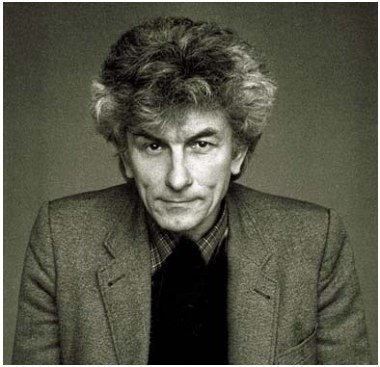
Imants Ziedonis
1933 – 2013
- Kapsēta
- Ragaciems Cemetery, Latvia
Imants Ziedonis broadened the ways poetry could speak about Latvian life. Alongside verse, he developed short prose pieces known as epiphanies, in which an ordinary encounter could become a meditation on perception, responsibility or belonging. His writing brought together curiosity about people and close attention to the natural world. His cultural activity also extended beyond books. Travel, public engagement and efforts to protect places and traditions connected literary imagination with practical care for Latvia. Song settings brought his words to audiences who might not otherwise encounter poetry. Ziedonis remains important both as an inventive writer and as a figure who encouraged others to look closely at their surroundings and take responsibility for them. Ziedonis was born on 3 May 1933 in Ragaciems, into a fisherman’s family on the Gulf of Riga. He attended Tukums High School No. 1 and later graduated from the Latvian State University’s Faculty of History and Philosophy. His education also included the Higher Courses for Literature in Moscow. His first published work appeared in 1956, followed by his first poetry collection in 1961. He emerged with a generation educated under Soviet rule whose arrival in publishing changed the literary landscape of Latvia in the early 1960s. [3] The restrictions of that environment shaped the means available to a writer. Open criticism was constrained, and Ziedonis sought forms of expression whose complexity could make them difficult for censors to interpret. His readership nevertheless became exceptionally large: poetry volumes appeared in print runs reaching tens and sometimes hundreds of thousands, and sold out. Together with Ojārs Vācietis, also born in 1933, he became a prominent presence in Latvian intellectual life. Their poetry evenings attracted listeners across generations, bringing unconventional thought into public discussion despite the limits surrounding cultural expression. [3] Several works marked distinct developments in his writing. Motocikls helped establish poetry theatre in Latvia. The two parts of Kurzemīte, published in 1970 and 1974, explored Latvian customs, everyday experience and culture through essays that also challenged an entirely favourable picture of Soviet life. Poēma par pienu, published in 1977, and Viddivvārpa, published in 1982, received particular recognition within his verse. His prose extended to forests and journeys in the Altai, Tajikistan and Karelia. The epiphanies reached readers in Lithuanian, English, German, Swedish and Ukrainian translation, while his fairy tales offered another setting for concentrated poetic language. [3] Writing for performance occupied a substantial part of his output. He supplied scripts for the films Pūt, vējiņi! and Puika, and wrote the libretto for Imants Kalniņš’s opera based on Rainis’s play Spēlēju, dancoju. He also provided words for Kalniņš’s oratorio Dzejnieks un nāra and adapted Aleksandrs Čaks’s poetry for the stage production Spēlē, spēlmani! Latvian composers, including Raimonds Pauls, set his poetry for choral and solo performance. Alongside this work, he translated Russian authors, among them Alexander Pushkin, Alexander Blok and Eduard Bagritsky. [3] As Soviet controls loosened during the 1980s, Ziedonis developed contacts with Latvians who had left the country in 1944 and 1945, including writers living in exile. Visits to the United States formed part of these exchanges, and his connections with Latvian communities there continued after independence was regained in 1991. An interview conducted by Ainars Meiers and published in Literatūra un Māksla in 1986 brought explicit criticism of the Soviet system into the Latvian press. From 1987 until 1992, Ziedonis chaired the Latvian Culture Foundation, assuming an institutional role during the period of national political change. [3] Elected to the Latvian Supreme Soviet, he voted on 4 May 1990 for the declaration restoring Latvia’s independence. His later public work included advising Prime Minister Guntars Krasts. He eventually relinquished his parliamentary mandate, explaining that he no longer saw a way to influence the country’s political development through it. In 1995 he received the Order of the Three Stars, Second Class. Continuing demand for editions of his books accompanied this public recognition, documenting a readership that persisted beyond the circumstances in which his earliest collections had appeared. [3]
Grāmatu “100 Latvijas personību”, kurā iekļauta arī šī personība, var iegādāties šeit.
The map marker shows the cemetery; the exact grave position is not yet established.
Sources & Further Reading
Books
- [3] Apinis, P. A Hundred Great Latvians. Nacionālais apgāds, Riga, 2006, pp. 154-155. ISBN 9984-26-288-X.