
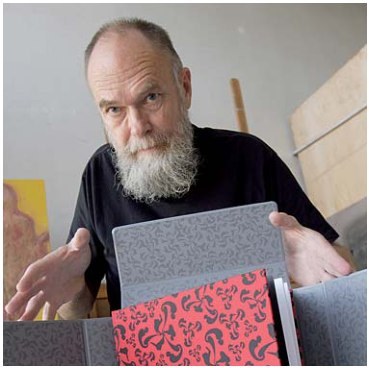
Ilmārs Blumbergs
1943 – 2016
- Kapsēta
- Burial location pending verification
Ilmārs Blumbergs worked across stage design, drawing, painting and graphic art. His images often carried an intense symbolic charge, allowing a figure or an object to suggest more than a single story. Theatre and opera gave that visual language a spatial and dramatic setting. Rather than treating design simply as decoration, he helped shape the atmosphere and interpretation of a production. His work outside the theatre pursued related questions through other materials and formats. The variety of his practice makes him an important figure in Latvia's late twentieth-century visual culture. Born in Riga on 6 September 1943, Blumbergs studied at the Riga School of Applied Arts, graduating in 1963, and completed his education at the Art Academy of Latvia in 1972. He had already begun exhibiting in 1962. His long association with the Daile Theatre included service as its chief artist from 1963 to 1985. Across his career, he designed more than fifty productions for Latvian theatres. The chapter records participation in over 285 exhibitions, reflecting an extensive public record beyond his work for particular stages and companies. [2] A decisive early production was A. Upīts’s Jeanne d’Arc at the Riga Theatre of Russian Drama in 1972. Created as his academy diploma project, its setting began as an almost empty white space. Objects brought on by the performers gradually accumulated into the structure of Jeanne’s execution pyre. The changing arrangement made the development of the stage inseparable from the action. International reference works subsequently identified the production as an important example of twentieth-century kinetic scenography. It also established a significant point of departure in Blumbergs’s own theatrical work. [2] Further recognition followed through productions of Ibsen. His design for Brand at the Daile Theatre received first prize at the Baltic stage-design triennial in Vilnius in 1977; Peer Gynt at Riga’s Youth Theatre received the corresponding award in Tallinn in 1980. Later opera designs included Verdi’s Aida, directed by M. Ķimele, which earned a Latvian Artist of the Year gold medal in 1998. Mozart’s The Magic Flute, directed by Viesturs Kairišs in 2001, brought a silver medal at the 2003 Prague Quadrennial. He also collaborated with Kairišs on a film associated with that production for the Venice Art Biennial. [2] Graphic exhibitions became part of his activity from 1971. Among his cycles were Meeting on the Road, All is One, One-Angled Life and Atlantis. All is One won the Grand Prix at Riga’s second international miniature graphics exhibition in 1987. His coloured silkscreen cycle Road to Nowhere received the Grand Prix at the Tallinn Graphics Triennial in 1989. Theatre posters formed another substantial body of work, with designs for productions including Romeo and Juliet, Medea and Dragon. The chapter records frequent poster awards from 1971 onward and the presence of his graphics in private and public galleries internationally. [2] Book design supplied a further field for sustained achievement. His illustrations for Chinghiz Aitmatov’s The Scaffold won the Grand Prix at the Baltic book-art triennial in Vilnius in 1990. In 1996 the German Commission for UNESCO recognized his design of Imants Ziedonis’s Epiphanies in an international competition for book design. Latvian publishers’ awards also honoured his work on Hesiod’s Theogony and Works and Days in 1995, Guntis Berelis’s history of Latvian literature in 1999, and Nietzsche’s The Birth of Tragedy from the Spirit of Music in 2006. [2] Venice became an important setting for his later exhibitions. He participated in the 49th Venice Biennial in 2001 and presented the solo exhibition Prayer for Seeing in 2004, receiving Latvia’s annual grand prize in visual art for it in 2005. The installation at San Ludovico included twenty-four pairs of feet in the altar, enlarged photographs of an ash-covered body and a fifty-metre drawing moved through a specially constructed mechanism. A 2006 volume gathered his Venice-related work. His broader cultural contribution was recognized with the Order of the Three Stars in 1995 and honorary membership of the Latvian Academy of Sciences in 2001. [2]
Grāmatu “100 Latvijas personību”, kurā iekļauta arī šī personība, var iegādāties šeit.
The resting place has not yet been established.
Sources & Further Reading
Books
- [2] Apinis, P. A Hundred Great Latvians. Nacionālais apgāds, Riga, 2006, pp. 188-189. ISBN 9984-26-288-X.