
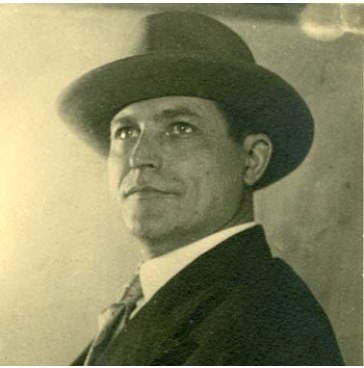
Gustavs Klucis
1895 – 1938
- Kapsēta
- Exact burial location not verified in this record; do not infer a grave from place of execution
Gustavs Klucis became an influential figure in the development of photomontage and Constructivist graphic design. By combining photographs, typography and forceful geometric arrangements, he helped create a visual language suited to posters and mass communication. Much of his output served Soviet political propaganda, including the promotion of Stalin’s regime. That involvement is an essential part of the work’s history, alongside its formal innovation. Klucis himself was arrested and executed during the purges in 1938. His career therefore brings artistic experimentation, political commitment and state violence into the same biography. Born on 4 January 1895 in Valmiera District, Klucis received his first sustained artistic training in Riga. From 1913 to 1915 he attended the Riga City Art School, studying with Janis Rozentāls, Vilhelms Purvītis and Jānis Roberts Tillbergs. He then continued his education at the Imperial School of the Society for the Promotion of Arts in Petrograd between 1915 and 1917. Military service followed in 1917. He participated in both the February Revolution and the Bolshevik seizure of power that October, and subsequently volunteered for the 9th Latvian Rifle Regiment. [2] Klucis remained in Russia after the Civil War, unlike riflemen who returned to Latvia. He joined the Communist Party in 1919 and supported the ideal of equality. His artistic education continued within the new Soviet institutional environment: between 1918 and 1921 he worked at the Latvian Riflemen Art Studio in the Kremlin, attended the studios of I. Mashkov and V. Meshkov, and studied under Kazimir Malevich at the State Free Art Workshops. This period brought his military and revolutionary experience into contact with experimental approaches to artistic form. [2] His early montage experiments date to 1918 and include Attack. Latvian Riflemen and Dynamic Town. He subsequently applied the technique to posters, publications and designs intended for political communication. Following Lenin’s death in January 1924, he moved away from abstraction and concentrated on photographic imagery assembled for propaganda. Teaching occupied another part of his working life: from 1921 to 1930 he taught at the Art and Culture Institute and the Typographic Institute. Book illustration was especially important during these years, and in 1925 he supplied eight illustrations for Vladimir Mayakovski’s poem V. I. Lenin. [2] Between 1929 and 1935 Klucis produced more than one hundred Constructivist posters. In a statement published in 1931, he described montage as a means of coordinating photographs, colour, written messages, lines and flat shapes to intensify visual expression. Sporting subjects gave him opportunities to arrange bodies diagonally and contrast their sizes, suggesting speed, strength and agility. These images belonged to a setting in which Soviet officials promoted athletic achievement as evidence of national power. His sports posters and postcards joined physical action to political slogans, and the chapter credits their ideas with subsequent influence on sports presentation internationally. [2] His larger exhibition work included Soviet displays and pavilions in Berlin in 1923, Paris in 1925 and 1937, Cologne in 1928 and Brussels in 1929. Yet his surviving work extends beyond public propaganda: it includes oils, watercolours, pastels, photographs and drawings in several media. He drew extensively while in Paris during the summer of 1937 and made watercolour studies in his final years. The purges that struck Latvians in Soviet institutions also reached him. Condemned on an allegation of involvement in a Latvian nationalist and fascist plot, he was shot at the Butov firing range in Moscow on 26 February 1938. [2] Klucis had begun exhibiting in 1918, and exhibitions continued after his death. His work entered collections including New York’s Museum of Modern Art, the Russian State Archives of Literature and Art, and the Hoover Institution Archives. The Latvian National Museum of Art holds examples of his poster and postcard designs, including a study connected with the 1928 Moscow Spartakiad. These holdings preserve both finished imagery and evidence of his working methods. In 1977 the Riga Film Studio produced The Time of Posters, extending the examination of his life and work into documentary film. [2]
Grāmatu “100 Latvijas personību”, kurā iekļauta arī šī personība, var iegādāties šeit.
The resting place has not yet been established.
Sources & Further Reading
Books
- [2] Apinis, P. A Hundred Great Latvians. Nacionālais apgāds, Riga, 2006, pp. 104-105. ISBN 9984-26-288-X.
Web resources
- [1] Gustav Klutsis