
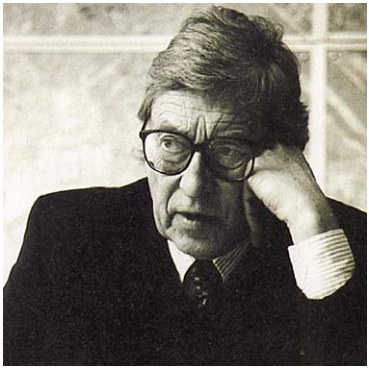
Gunnar Birkerts
1925 – 2017
- Kapsēta
- Burial location not verified in this record
Gunnar Birkerts, also known as Gunārs Birkerts, developed an international architectural career after leaving Latvia during the Second World War. Working mainly in the United States, he became known for inventive relationships between form, function and natural light. Libraries, museums and other civic buildings formed important parts of his practice. His design for the National Library of Latvia created a particularly visible connection between his adopted professional environment and the country of his birth. That building’s cultural meaning complements the practical demands of storing collections and welcoming readers. He also taught architecture, extending his influence through students and colleagues. Born in Riga on 17 January 1925, Birkerts grew up in a family closely connected with Latvian scholarship. His father, Pēteris Birkerts, worked in folklore, philosophy and literature, and collected folklore with his brother Anton before the war. His mother, Mērija Saule-Sleine, was a teacher, linguist and folklorist. Their household valued literature, the arts and knowledge of Latvia’s cultural past. In 1945 he began studying at the Technische Hochschule in Stuttgart, where the architect Rolf Gutbrod was among his teachers. He completed his diploma in architecture and engineering in 1949 and moved to the United States that year. [2] His early American employment placed him in two prominent architectural offices. Between 1951 and 1955 he worked with Eero Saarinen in Bloomfield Hills, Michigan. From 1956 to 1959 he served as chief designer at Minoru Yamasaki & Associates, before establishing Gunnar Birkerts & Associates in 1959. During these years he also began a family: he married Silvija Zvirbule in 1950. Their children were Svens Pēteris, born in 1951, Andra Silvija, born in 1954, and Eriks Gunārs, born in 1967. [2] The independent practice undertook more than 160 projects, encompassing churches, educational buildings, offices and cultural institutions. Its geographical reach extended from the Contemporary Arts Museum in Houston and the Federal Reserve Bank in Minneapolis to the United States Embassy building in Caracas. Other commissions included the headquarters of Domino’s in Ann Arbor and the Museum of Contemporary Art in Kansas City. The Minneapolis bank dates from 1971–1973, while the chapter also documents Duluth Public Library in 1979 and work for Ohio State University’s law school between 1988 and 1993. [2] Birkerts’s architectural approach involved more than bringing daylight into rooms. He used direct, reflected and diffused light to address both a building’s practical requirements and the character of its interiors. The chapter also emphasizes his attention to the site, its social environment and the properties of construction materials. His academic career developed alongside this practice. His teaching at the University of Michigan extended from 1961 to 1990, and he also held distinguished professorships at the universities of Oklahoma and Illinois. In 1975 he was architect in residence at the American Academy in Rome. [2] For the Riga library project, Birkerts drew on a tale in which a princess must be rescued from a glass mountain. The design also referred to the cultural awakening associated with the Young Latvians and to Rainis’s treatment of the mountain and its climber, Antiņš. His sketches from the 1980s placed the proposed building across the Daugava from Old Riga. Glass and ascending forms connected this literary inheritance with a modern architectural vocabulary. The design received the American Architecture Prize from the Chicago Museum of Architecture and Design in 2000. [2] Recognition came through professional institutions as well as individual buildings. Birkerts became a fellow of the American Institute of Architects, an honorary member of the Latvian Architects’ Association and an overseas member of the Latvian Academy of Sciences. Riga Technical University awarded him an honorary doctorate. The chapter records fifty-eight major awards for his buildings and his receipt of the Arnold W. Brunner Memorial Prize in Architecture. Latvia’s Academy of Sciences conferred its Grand Medal, and he received the Order of the Three Stars in 1995. The Minneapolis bank was also proposed for architectural monument status before reaching the usual fifty-year threshold. [2]
Grāmatu “100 Latvijas personību”, kurā iekļauta arī šī personība, var iegādāties šeit.
The resting place has not yet been established.
Sources & Further Reading
Books
- [2] Apinis, P. A Hundred Great Latvians. Nacionālais apgāds, Riga, 2006, pp. 138-139. ISBN 9984-26-288-X.