
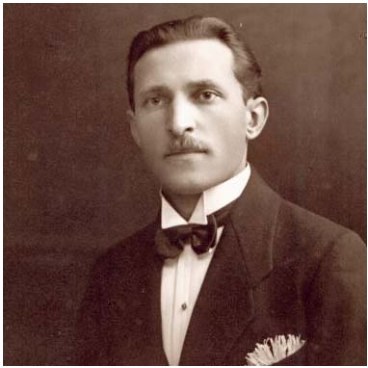
Francis Trasuns
1864 – 1926
- Kapsēta
- Rēzekne War Cemetery, Latvia, according to the book
Francis Trasuns combined the work of a Catholic priest with journalism, education and political organisation. He argued that Latgale’s population should participate in a common Latvian political future while retaining its own linguistic and cultural traditions. His activity included service in the Russian State Duma and later in Latvia’s parliament. The question of uniting Latgale with the other Latvian regions was a central concern of his public work. His career also involved conflict within church institutions, demonstrating that religious and political responsibilities did not always align. Trasuns died in Riga in 1926. The administrative position of Latgale formed an important background to Trasuns’s work. Under Russian imperial rule, the region belonged to Vitebsk Province rather than sharing a provincial administration with the other Latvian territories. Russification also affected its written culture: the chapter dates to 1870 a prohibition on printing or importing books using Latin or Gothic characters. Trasuns campaigned against the restriction on Latin script and promoted the Latgallian National Awakening. His educational and publishing activities developed within this setting of regional separation and restrictions on the circulation of printed material. [2] Born in Rēzekne District on 16 October 1864, Trasuns came from a Latgallian peasant family. He attended Jelgava Real Gymnasium before continuing at the Ecclesiastical Seminary and Ecclesiastical Academy in St Petersburg, graduating from the latter in 1891. During his seminary years, he wrote a Latgallian grammar and began teaching the language. From 1892 his work took him to Daugavpils, Riga, Rēzekne and St Petersburg. In these places he publicly encouraged Latvian unity and national self-respect. In 1896 he was accused of undermining the tsarist order and exiled to Vladimir. [2] From 1901 Trasuns worked in Polotsk and St Petersburg, and between 1902 and 1905 he held a professorship at the Ecclesiastical Academy. His publishing work included the Daugavas katoļu kalendārs, issued during 1900–1904. He returned to Rēzekne in 1904 and two years later won election to Russia’s First State Duma as a representative of Vitebsk Province. That parliamentary opportunity was brief: the Duma was dissolved in 1906. Police surveillance of Trasuns continued afterward and lasted until 1917, covering more than a decade of his subsequent public activity. [2] A decisive institutional step came with the Latgale Congress in Rēzekne on 9 and 10 May 1917, convened at his suggestion. The delegates resolved that Latgale should join the other Latvian regions, and Trasuns was elected to the Latgale Provincial Council. He subsequently belonged to the National Council that proclaimed the Republic of Latvia on 18 November 1918. In 1920 he headed the government’s Department of Latgale Affairs with ministerial authority. He also served in the Constituent Assembly and, from 1922, in the Saeima. The chapter’s parliamentary illustrations identify him with the first Saeima’s Juridical Commission and as a deputy secretary of parliament. [2] Disagreement over Latgale’s political future also entered his relations with ecclesiastical authority. The chapter describes Archbishop Boleslaw Springowicz as supporting a separation of Latgale that could lead to its incorporation into Poland, and as seeking Trasuns’s political cooperation. Trasuns did not support that course. In 1924 he was forbidden to exercise his priestly duties, and in 1925 he was excommunicated. These measures took place while he remained a public political figure; the chapter also records that he was recognised as Latvia’s most popular politician in 1925. [2] The exclusion extended into the circumstances of his final days and burial. Before his death from a stroke on 6 April 1926, he was removed from the entrance area of St Jacob’s Church during Easter. He had previously defended the church’s return to a Catholic congregation in parliamentary debate. Permission to bury him in Rēzekne’s Catholic cemetery was refused, and he was instead interred in the nearby War Cemetery. The ecclesiastical judgment was reconsidered much later: in 1998 the Vatican restored his good name, providing a documented posthumous reversal of the treatment he had received. [2]
Grāmatu “100 Latvijas personību”, kurā iekļauta arī šī personība, var iegādāties šeit.
The map marker shows the cemetery; the exact grave position is not yet established.
Sources & Further Reading
Books
- [2] Apinis, P. A Hundred Great Latvians. Nacionālais apgāds, Riga, 2006, pp. 56-57. ISBN 9984-26-288-X.