
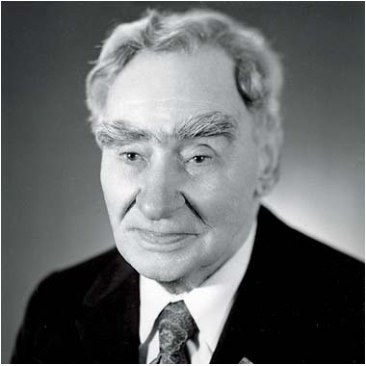
Ēvalds Valters
1894 – 1994
- Kapsēta
- Brothers’ Cemetery / Brāļu kapi, Riga, Latvia
Ēvalds Valters’ long life connected the generation of the Latvian riflemen with the restoration of independence at the end of the twentieth century. He worked as an actor across theatre and film, bringing a recognisable presence to a wide range of roles. His interests also included languages, translation and writing. In later life he became a public figure whose experience gave particular weight to participation in the national awakening. His work belonged to collaborative theatrical institutions and changing political settings. He died in Riga at the age of one hundred and was buried in the Brothers’ Cemetery. Before entering professional theatre, Valters learned several practical occupations, including gardening, pottery, bricklaying and carpentry. Born in Kuldīga on 2 April 1894, he entered a Riga gymnasium in 1912, where his studies included English, German and French. His first acting experience came during military service in the First World War. Serving as a scout in the Latvian riflemen’s ranks, he also joined their theatrical activities. At Dubulti in Jūrmala, he played an innkeeper in a dramatisation of Mērnieku laiki, beginning a connection with that literary work that would later continue on the professional stage. [2] Formal training followed in Moscow between 1920 and 1922, at the Latvian theatre studio Skatuve and the film actors’ workshop Tvorchestvo. In 1923 he joined the New Theatre of Liepāja. His responsibilities there extended beyond performance: he taught in the drama studio of the People’s University, directed its drama club and participated in establishing Liepāja’s opera institution. Eduards Smiļģis invited him to Riga in 1928 to work at the Daile Theatre. During the following decade, Valters also held chief directing positions at community theatres in Daugavpils, Jelgava and Riga, alongside work for Latvian Radio. [2] His stage repertoire eventually exceeded 250 roles across different theatres. At Daile he portrayed Ķencis in Mērnieku laiki in 1933. Two productions directed by Smiļģis in 1958 placed him in contrasting dramatic settings: he appeared as Džeksons in Gunārs Priede’s Normunda meitene and as Cavalier Kevenhiller in an adaptation of Selma Lagerlöf’s Gösta Berlings Saga. From 1941 onward, Daile remained his theatrical home. He continued preparing programmes and learning parts after his ninetieth birthday. His final Daile role, in 1987, was the Rifleman–Passer-by in a staging of Aleksandrs Čaks’s Mūžības skartie. [2] Cinema offered another substantial field of work. His screen debut was as Old Kļava in The Fisherman’s Son in 1939, followed by appearances in approximately forty films. Many were adaptations of Latvian literature, and the chapter records that he did not single out a favourite role. His knowledge of French also supported translations of Racine’s Britannicus, Molière’s Don Juan and The Misanthrope, and La Fontaine’s fables. His own poem Russiada took a sharply critical view of the Soviet system. Sent secretly to Sweden in 1955 under the pseudonym Ints Baltarājs, it was published by the Latvian National Foundation with a preface by Andrejs Eglītis. [2] During the Third National Awakening, his public appearances included opening the Latvian Popular Front’s founding congress on 8 October 1988. In 1989 he and the writer Alberts Bels raised Latvia’s red-white-red flag above Riga Palace’s Holy Spirit Tower. His earlier military experience also had a documentary significance: his reconstruction preserved an address delivered to the riflemen by Jukums Vācietis at Piņķi. Following the recovery of independence, Valters supported the prompt establishment of Latvia’s national armed forces. As a reserve officer, he received an officer’s sword on his hundredth birthday. [2] Recognition in his final years included election as an honorary member of the Latvian Academy of Sciences in 1992. He remained a performer even at one hundred, joining singer Mirdza Zīvere for a song at a concert. The chapter also describes the books, papers and manuscripts that filled his working space, which he nevertheless kept in an order that allowed him to locate what he needed. These details accompany a record of continued participation in theatrical, literary and public life across his last decades. [2]
Grāmatu “100 Latvijas personību”, kurā iekļauta arī šī personība, var iegādāties šeit.
The map marker shows the cemetery; the exact grave position is not yet established.
Sources & Further Reading
Books
- [2] Apinis, P. A Hundred Great Latvians. Nacionālais apgāds, Riga, 2006, pp. 100-101. ISBN 9984-26-288-X.