
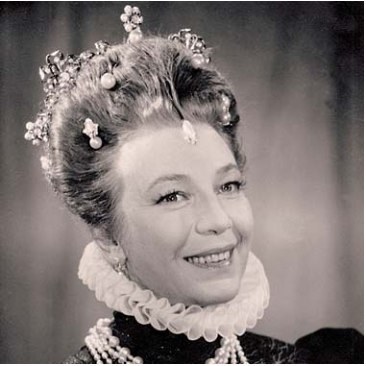
Elza Radziņa
1917 – 2005
- Kapsēta
- Forest Cemetery / Meža kapi, Riga, Latvia
Elza Radziņa developed a career that joined major theatre roles with film and spoken-word performance. Her work at the Latvian National Theatre made her one of the country’s recognisable stage personalities, while cinema brought her to audiences outside Latvia. Her interpretation of Gertrude in Grigori Kozintsev’s Hamlet is an important part of that international record. On stage, the range and authority of her performances grew from years of training and ensemble work rather than celebrity alone. Poetry readings and literary programmes added another dimension to her use of voice. Her professional life extended across several decades and political periods. She died in 2005 and was buried in Riga’s Forest Cemetery. Born in Kharkov on 10 February 1917, Radziņa received her schooling in Jelgava and graduated from Duke Peter Gymnasium in 1936. Her earliest theatre experience included appearances in crowd scenes, followed by formal preparation at the Jelgava Theatre Studio, which she completed in 1942. Between 1945 and 1953 she worked at the drama theatres of Jelgava and Valmiera. These years preceded her move to Riga in 1954, when director Alfrēds Amtmanis-Briedītis invited her to join the Drama Theatre, later renamed the Latvian National Theatre. [2] The invitation initially concerned Osiene in a renewed production of Andrejs Upīts’s Zaļā zeme. Another opportunity emerged when she asked to participate in the crowd scenes of Rūdolfs Blaumanis’s Skroderdienas Silmačos. During rehearsals she was asked to take Elīna’s part while Lidija Freimane was occupied elsewhere. Her performance led to her sharing the role, making Elīna her first character at the Riga theatre. Over the years she also played Antonija and Tomuļu māte in the same work. Her classical repertoire included Princess Eboli in Schiller’s Don Carlos in 1955. [2] An especially durable stage partnership developed with Kārlis Sebris. In Žanis Katlaps’s 1962 production of Jerome Kilty’s Dear Liar, she played Stella Campbell opposite his George Bernard Shaw. Their performances in this work continued across forty years. They appeared together again in Juhan Smuul’s Kihnu Jõnn, staged by Mihails Kublinskis in 1967, with Radziņa as Manne and Sebris as Jõnn. Later, she worked with her husband, actor and director Oļģerts Šalkonis, in Peter Eyre’s Chère Maître, playing George Sand opposite his Gustave Flaubert. [2] Her film work had begun before the move to Riga. In Yuli Raizman’s Rainis, released in 1949, she portrayed Dora Pliekšāne-Stučka, the poet’s sister and the wife of Pēteris Stučka. The film presented Rainis through the demands of post-war Soviet ideology, emphasising him as a Communist fighter. A different international reception followed Kozintsev’s Shakespeare adaptation: in 1965 Peter Brook praised Hamlet in Sight and Sound, and Radziņa travelled with fellow actors to premieres abroad. Kozintsev subsequently cast her as Goneril in his 1970 version of King Lear. [2] At the Riga Film Studio, her popular roles included Ģertrūde in The Devil’s Servants in 1970 and its 1972 sequel, The Devil’s Servants in the Devil’s Mill. Both reached audiences in numerous countries. Her own favourite screen role was Ance in Klāvs — Mārtiņš’ Son, released in 1971. Although a supporting character, this proud cattle herder and mother of three was presented as capable of answering the contempt of other village women with forceful words or action. Radziņa also appeared in Jānis Streičs’s Teātris in 1978. [2] Her literary performances included Latvian poetry, translated verse and a substantial repertoire of traditional songs: she knew approximately eight hundred folk songs. From 1980 to 1985 she toured Latvia with the ensemble Arājs, led by Māra Skride, in the programme Senā daina, kļūsti spīva. In 1985 she also performed folk-song material at the Kremlin Congress Palace. Later honours included the Order of the Three Stars in 1995, honorary membership of the Latvian Academy of Sciences in 1997, and the Lielais Kristaps award in 2003 for her longstanding contribution to Latvian cinema. [2]
Grāmatu “100 Latvijas personību”, kurā iekļauta arī šī personība, var iegādāties šeit.
The map marker shows the cemetery; the exact grave position is not yet established.
Sources & Further Reading
Books
- [2] Apinis, P. A Hundred Great Latvians. Nacionālais apgāds, Riga, 2006, pp. 134-135. ISBN 9984-26-288-X.
Web resources
- [1] Elza Radziņa