
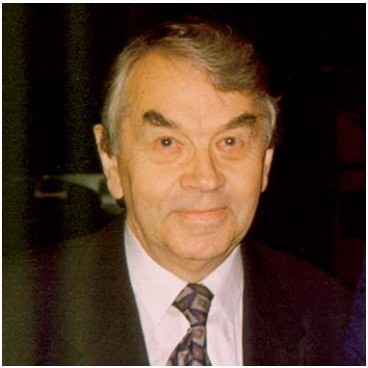
Edgars Siliņš
1927 – 1998
- Kapsēta
- Līgatne Cemetery, Latvia
Edgars Siliņš investigated the behaviour of electronic states and charge transport in organic materials. His research contributed to the understanding of molecular crystals, a field connecting chemistry, physics and the properties of materials. His route into academic work was shaped by the disruptions of war and the conditions of Soviet Latvia. Industrial laboratory experience formed part of a career that later produced influential scientific publications and international collaboration. He also reflected on the wider meaning of scientific knowledge, drawing on philosophical interests beyond his specialised research. Edgars died in 1998 and was buried in Līgatne. Born on 21 March 1927, Siliņš was the fourth child in a farming family. His university education began in 1948, when he entered the chemistry department of the Latvian State University. Alongside his studies, he served as a laboratory assistant in optics and spectroscopy within the Faculty of Physics and Mathematics. His family’s classification as wealthy farmers became an obstacle under the prevailing political conditions, forcing him to leave his university work. He resumed higher education only in 1957, this time studying physics and mathematics, and graduated with distinction in 1961. [2] By then he had gained substantial experience at the Riga Electric Machinery Plant, whose central laboratory he joined in 1951. There he organised an early facility for atomic spectroscopy and the spectral examination of metals and alloys. Across twelve years in industrial research, he published twenty-six papers and helped develop technological devices subsequently put into production. He also presented research at conferences across the Soviet Union. His university graduation project addressed a biophysical problem, leading him towards the molecular spectroscopy of organic compounds. In 1965 he completed his candidate’s degree, equivalent to a PhD, at the Leningrad Optical Institute. [2] A research group that Siliņš began leading at the university in 1963 acquired a new institutional home four years later. It became the Laboratory of Physics of Organic Semiconductors within the Latvian Academy of Sciences’ Institute of Physical Energetics. This remained his workplace for the rest of his career. In 1979 he obtained the higher degree of Doctor of Physical Sciences for research into electronic-state energies in organic molecular crystals. A Russian-language monograph appeared that year, followed in 1980 by an expanded English treatment published by Springer-Verlag. The English volume became a reference work for researchers internationally. [2] His later investigations developed through both theoretical work and collaboration abroad. A working visit to the Institute for Molecular Science in Okazaki, Japan, in 1985 was followed by further research on photogeneration in molecular crystals. That year he published a molecular-polaron model for polyacene crystals. In 1986 he and the Czech physicist V. Capek investigated mechanisms of charge-carrier transport. Their research contributed to a Russian monograph issued in Riga in 1988 and an English volume published by AIP Press in 1994. During the early 1990s, Siliņš also supervised investigations in molecular electronics. [2] Teaching and scientific organisation accompanied these publications. His students continued research in the field, while he worked to strengthen the Academy’s international cooperation after Latvia recovered its independence. Elected a full member of the Latvian Academy of Sciences in 1992, he received its Grand Medal in 1997. His cultural activities included supporting Latvian literary translations. In 1996, together with director Guntis Gailītis, he presented Valdis Bisenieks’s translation of Dante’s Divine Comedy to an audience of academics and professors at the Rotary Club. [2] During his final seven years, Siliņš wrote the philosophical essays collected in Search for the Great Truths. Their subjects extended from scientific understanding to art, ethics, religion and social questions, considered across historical and cultural settings. The Latvian book appeared in several editions and was subsequently translated into English. His scientific contribution also received lasting recognition: the Academy established a physics prize bearing his name in 1998, and the journal Molecular Crystals and Liquid Crystals devoted a special issue to his memory in January 2001. [2]
Grāmatu “100 Latvijas personību”, kurā iekļauta arī šī personība, var iegādāties šeit.
The map marker shows the cemetery; the exact grave position is not yet established.
Sources & Further Reading
Books
- [2] Apinis, P. A Hundred Great Latvians. Nacionālais apgāds, Riga, 2006, pp. 144-145. ISBN 9984-26-288-X.
Web resources
- [1] Edgar Silinsh