
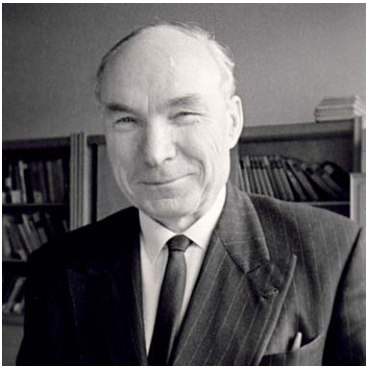
Edgars Dunsdorfs
1904 – 2002
- Kapsēta
- Rainis Cemetery / Raiņa kapi, Riga, Latvia; ashes interred in August 2002
Edgars Dunsdorfs continued research into Latvia’s past while living far from the country’s archives and institutions. Trained in economics and history, he worked with documentary evidence to examine social and economic change. After the Second World War he established a long academic career in Australia. His books and editorial work helped preserve historical discussion outside Soviet Latvia, while his involvement in community institutions supported Latvian cultural life in Melbourne. His wife Lilija’s library work formed part of that wider setting of preservation and access. Dunsdorfs died in Melbourne in 2002, and his ashes were subsequently interred in Riga. His biography connects scholarship, migration and the maintenance of cultural institutions across continents. Born in Saldus on 20 November 1904, Dunsdorfs studied economics and law at the University of Latvia. His published work on Latvian history began in 1924. After graduation he taught historical methodology, and in 1938 he became a professor at the university. Research undertaken from 1933 in previously unexplored Swedish archival collections supplied material for his doctoral study of the extensive Swedish cadastre of Livonia as evidence for economic history. His early scholarship received four Krišjānis Barons prizes and a Latvian Culture Foundation award in 1936. [2] Alongside historical research, he held several responsibilities in economic scholarship and publishing. He was deputy director of the Latvian Economic Research Institute, headed the university’s economics department, edited an economic dictionary and served as editor-in-chief of Latvju Tautsaimnieks. In the autumn of 1944 he and Lilija fled the advancing Soviet army and reached Germany. There he worked at the Greifswald Institute of Economic Research. In 1946 he helped initiate the Baltic University, established to provide education for refugees, and became rector of its Latvian section. [2] After moving to Australia in 1948, Dunsdorfs began teaching at the University of Melbourne. The university granted him a commerce degree in 1956, and he headed its Department of Economic History. His appointment as professor followed the acquisition of Australian citizenship in 1968; he became professor emeritus in 1970. His academic contacts also extended to visiting professorships at the University of California, Berkeley, in 1957 and at Uppsala and Stockholm in 1962. These appointments connected his Australian work with universities in North America and Sweden. [2] His research ranged from the twelfth to the twentieth century and resulted in fifty-nine books as well as numerous articles. For the six-part history of Latvia issued by the émigré publisher Daugava, he contributed three volumes. The study covering 1600–1710 appeared in 1962; the volume on 1500–1600, written with Arnolds Spekke, followed in 1964; and the treatment of 1710–1800 appeared in 1973. His compilation of Latvian maps dating from the seventeenth through nineteenth centuries was another substantial contribution to the historical resources described in the chapter. [2] Editorial work also addressed the circumstances of Latvians living outside their homeland. Between 1960 and 1993 he compiled and edited thirty-one volumes of Archīvs, which included approximately one hundred of his own articles on Latvian historical questions. He chaired the Melbourne Latvian Society in 1949–1950 and the Kārlis Zariņš Foundation from 1959, and organised scout camps for young people. At the society’s library he assembled an almost complete collection of Latvian literature published in exile. Lilija directed that library for fifty years, from 1950 until 2000. [2] An agronomist by profession, Lilija also assisted with the preparation of his study of Australian wheat growing between 1788 and 1948, published in 1956. Her help with later publications was particularly important after a car accident in 1985 temporarily incapacitated him. Recognition from Latvian institutions included honorary membership of the Academy of Sciences in 1990, its Grand Medal in 1994 and an honorary doctorate from the University of Latvia in 1996. In June 1995 Latvia’s consul in Australia, Emīls Dēliņš, presented him with the fourth-class Order of the Three Stars, with Lilija present. [2]
Grāmatu “100 Latvijas personību”, kurā iekļauta arī šī personība, var iegādāties šeit.
The map marker shows the cemetery; the exact grave position is not yet established.
Sources & Further Reading
Books
- [2] Apinis, P. A Hundred Great Latvians. Nacionālais apgāds, Riga, 2006, pp. 124-125. ISBN 9984-26-288-X.