
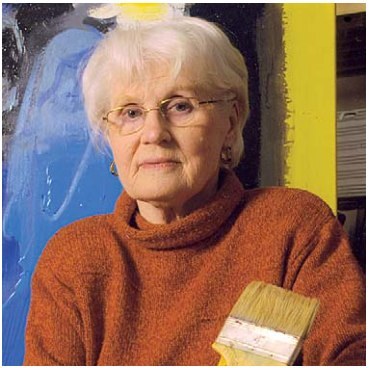
Džemma Skulme
1925 – 2019
- Kapsēta
- Burial location not verified in this record
Džemma Skulme explored strength, vulnerability and collective memory through painting. Figures associated with folk culture and the recurring image of the caryatid became part of a visual language that combined personal expression with wider social meanings. She came from a family of artists and worked within the institutions of Soviet Latvian art, later taking a prominent role in public life during the national awakening. Her career therefore involves both artistic decisions and the changing responsibilities of a cultural leader. Born in Riga on 20 September 1925, Skulme attended Riga State Gymnasium No. 1 before studying monumental painting at the Art Academy of Latvia. Her diploma painting was Dziesmu svētki, or Song Festival. She then pursued postgraduate study at the Repin Institute of Painting, Sculpture and Architecture in Leningrad. In 1956 she received a postgraduate degree in art science for Mūsu svētki, or Our Celebration. Her formal education thus included both the Latvian academy and a major institution of artistic training elsewhere in the Soviet Union. [2] Her family’s professional connections reached across painting, sculpture, criticism and theatre. Her father, Oto Skulme, served as rector of the Latvian academy and directed its monumental painting workshop. He also designed productions for the National Theatre, National Opera and Daile Theatre, working closely with E. Smiļģis at the latter. Her mother, Marta, was the first Latvian woman with formal academic training in sculpture. Oto, Marta and Džemma’s uncle Uga belonged to a Riga artists’ group influential in the development of Latvian art during the 1930s. [2] During the 1950s Skulme became known for book illustration, working with ink washes, red chalk and watercolour. Painting increasingly occupied her attention in the following decade. Her earlier lyrical approach gave way to stronger dramatic expression, broader strokes, palette-knife work, varied surface textures and emphatic colour. She also worked in oil and acrylic and refined her use of the alla prima method. From the 1970s onward, her caryatid paintings explored women’s moral and spiritual strength. Archers and Latvian women were other recurring subjects within her work. [2] Her paintings circulated through exhibitions in Latvia and abroad, including France, Sweden, Italy, Germany and the United States. Individual exhibitions were also held in Austria and Canada. Works entered the Latvian National Museum of Art, Moscow’s Tretyakov Gallery and the Zimmerli Art Museum in the United States, as well as private collections belonging to the Danish royal family and Boris Yeltsin. The Latvian national collection includes A Macedonian Motif from 1974 and War Caryatids from 1976, examples of the period in which her forceful figurative language developed. [2] For many years Skulme served on the board of the Latvian Artists’ Union and as its president. Under her leadership, the April Art Days of the 1970s and 1980s brought exhibitions and public events to large audiences, including gatherings in Riga’s Dome Square. Her institutional standing also included election to the USSR Supreme Soviet. In 1987, during the vote to remove Boris Yeltsin from the Soviet Presidium, she alone among more than 1,500 members abstained. The following year she publicly opposed proposed legislation that would have assigned specific powers to the Soviet internal military forces. [2] The wider family also experienced conflict with Soviet authority. Uga Skulme was compelled to abandon his artistic positions, while his son Jurģis was imprisoned in 1978 for criticising the system. Džemma’s husband, Ojārs Ābols, was both an artist and a theorist; her son Juris Dimiters moved from stage design into surrealist painting and political posters. Her own distinctions included honorary membership of the Latvian Academy of Sciences in 1992, an honorary doctorate from the Art Academy of Latvia, the rank of Commander in the Order of the Three Stars and a lifetime Culture Capital Foundation grant. [2]
Grāmatu “100 Latvijas personību”, kurā iekļauta arī šī personība, var iegādāties šeit.
The resting place has not yet been established.
Sources & Further Reading
Books
- [2] Apinis, P. A Hundred Great Latvians. Nacionālais apgāds, Riga, 2006, pp. 140-141. ISBN 9984-26-288-X.