
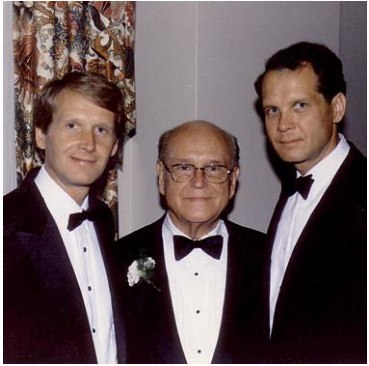
Christopher Kristaps Zarins
1943 –
Christopher Kristaps Zarins developed a career in vascular surgery, combining clinical work with research into the circulation and diseases of blood vessels. His association with Stanford placed that work within an academic environment linking medicine, science and technological development. Alongside his American career, he contributed to professional connections with Latvia. Exchanges and support for medical education helped make diaspora expertise available to clinicians and institutions there. His work illustrates how an international academic career can retain ties to a family's country of origin. Born in Tukums on 2 December 1943, Christopher Kristaps Zarins spent his earliest years amid the displacement of his family. His father, Richards Zarins, had served as a Lutheran minister at Riga’s Dome Cathedral since 1938. In the autumn of 1944 the family escaped to Sweden as Soviet forces entered Latvia. Two years later Richards accepted responsibility for the Latvian Lutheran congregation in New York, beginning a ministry that would extend for more than fifty years. Christopher’s brother Bertram, born in 1942, also pursued a medical career. [2] The New York congregation provided an extensive institutional setting for the family’s life abroad. Its membership increased from 200 in 1946 to 3,750 in 1966, with schools, choirs, camps and property serving the growing community. Between 1948 and 1952 Richards met 287 ships carrying more than 10,000 Latvian refugees into New York harbour. Although services took place at several locations, the congregation remained united. Christopher, Bertram and their sister Antra later joined their parents, Richards and Marija, in celebrating their fiftieth wedding anniversary in 1986. [2] Christopher completed his medical education at Johns Hopkins University and his surgical residency at the University of Michigan. His academic appointments included service as professor and head of vascular surgery at the University of Chicago, followed by the posts of Chidester Professor of Surgery and head of vascular surgery at Stanford’s medical school. Recognition of his research included an award from the Association for Academic Surgery in 1972. In 1998 he received the Pauls Stradiņš Prize in Medicine from the Latvian Academy of Sciences, which also elected him a foreign member. [2] His professional activity extended well beyond his university appointments. The chapter records editorial leadership or board membership at more than ten specialist journals and membership in thirty-eight professional organisations across the United States, Latvia and the Baltic region. It also credits him with presidencies of eight international professional associations in the United States and Austria. His scholarly output included more than five hundred presentations and theses, co-authorship of 310 scientific papers, contributions of 118 chapters to medical books, and authorship or co-authorship of six books. [2] A major public undertaking brought Christopher and Bertram together in organising the first World Congress of Latvian Physicians in Riga in June 1989. Bertram had proposed the gathering in 1987, while Latvia remained under Soviet occupation. More than one hundred Latvian physicians came from abroad. On 18 June, Christopher joined Bertram, Kristaps Keggi and Viktors Kalnbērzs at the head of a procession of six thousand physicians through Riga. The congress established contacts between doctors in Latvia and their colleagues overseas, and the brothers continued organising such congresses at four-year intervals. [2] Their other activities included leadership of the Latvian Medical and Dental Association and the establishment and leadership of the Latvian Medical Foundation. They supported bursaries, specialised training and access to newer medical technology. Individual clinical contributions were also documented: while in Chicago, Christopher arranged an operation for a two-year-old Latvian girl with a congenital heart defect, who returned home in 1991. In Riga in 1997, he and Dainis Krieviņš performed the Baltic countries’ first endovascular repair of a thoracic aortic aneurysm. Christopher, his father and his brother each received Latvia’s Order of the Three Stars. [2]
Grāmatu “100 Latvijas personību”, kurā iekļauta arī šī personība, var iegādāties šeit.
Sources & Further Reading
Books
- [2] Apinis, P. A Hundred Great Latvians. Nacionālais apgāds, Riga, 2006, pp. 180-181. ISBN 9984-26-288-X.