
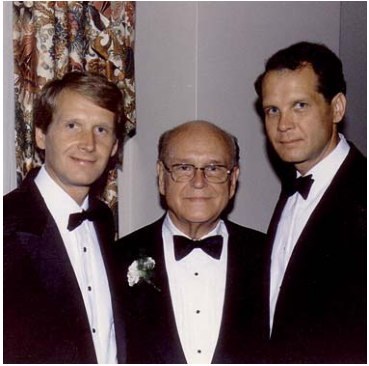
Bertram Zarins
1942 –
Bertram Zarins built a career in orthopaedic surgery and sports medicine in the United States. His work at Massachusetts General Hospital and Harvard connected clinical practice with teaching and research. He became associated particularly with the care of sports injuries and the development of arthroscopic practice. His professional connections also supported medicine in Latvia. Training, exchanges and philanthropic activity helped link Latvian clinicians with colleagues abroad. Those contributions form part of a wider history in which exile and diaspora communities maintained practical relationships with their country of origin. Zarins was born in Tukums on 22 June 1942 into the family of the Lutheran minister Richards Zarins. His father had served at Riga’s Dome Cathedral since 1938. In the autumn of 1944 the family fled to Sweden, and in 1946 Richards became minister of the Latvian Evangelical Lutheran Church in New York. The congregation grew substantially as refugees arrived after the war. Between 1948 and 1952, he met 287 ships carrying more than ten thousand Latvian refugees, assisting their arrival and settlement in America. [2] The church around which the family’s American life developed provided more than worship. It maintained schools, choirs and summer camps, while services took place at several locations. Richards preserved its unity through decades of growth. Bertram subsequently pursued medical education in Syracuse, New York, then undertook general surgical training at Johns Hopkins Hospital in Baltimore. He completed his specialist preparation through the Harvard orthopaedic surgery residency programme. His younger brother, Christopher Kristaps Zarins, also became a surgeon, specialising in vascular surgery and holding senior academic and clinical posts. [2] Bertram’s clinical responsibilities included leadership of the Sports Medicine Service at Massachusetts General Hospital in Boston. In 2006 he was appointed to Harvard Medical School’s Augustus Thorndike professorship in orthopaedic surgery. His sports appointments developed over several decades: he served as physician to the Boston Bruins from 1976, the New England Patriots from 1982 and the New England Revolution from 1996. In 1984 he was head physician for the United States Olympic team at the Winter Games in Sarajevo. He also spent twelve years on the United States Olympic Committee’s Sports Medicine Council. [2] Professional work outside those appointments included chairing the American Academy of Orthopaedic Surgeons’ sports medicine committee and serving as a voting member of the United States Food and Drug Administration. He held editorial responsibilities with several medical journals, including a consulting editorship at the Journal of Bone and Joint Surgery, and wrote, co-wrote or edited medical books and scientific papers. The chapter also identifies him as honorary president of the Spanish Arthroscopy Association. In Latvia he introduced arthroscopy, became a foreign member of the Academy of Sciences in 1991 and served as an international expert for the Latvian Council of Science. [2] In 1987 he proposed a worldwide gathering of Latvian physicians in Riga, which remained under Soviet rule. The resulting congress took place in June 1989, bringing more than a hundred physicians from abroad to meet colleagues in Latvia. Bertram and Christopher were among its organisers. On 18 June they joined Kristaps Keggi and Viktors Kalnbērzs at the head of a procession of approximately six thousand physicians through Riga. The gathering combined professional discussion with a conspicuous public presence during the period of Latvia’s movement towards renewed independence. [2] The brothers’ subsequent activities included organising further congresses at four-year intervals, supporting doctors and students with bursaries and specialised training, and supplying modern medical technology. They led the Latvian Medical and Dental Association and established and led the Latvian Medical Foundation. Latvia awarded the Order of the Three Stars to Bertram, Christopher and their father. These family distinctions accompanied a range of specific contributions, from Richards’s assistance to refugees to his sons’ clinical, educational and organisational work linking physicians in Latvia with colleagues overseas. [2]
Grāmatu “100 Latvijas personību”, kurā iekļauta arī šī personība, var iegādāties šeit.
Sources & Further Reading
Books
- [2] Apinis, P. A Hundred Great Latvians. Nacionālais apgāds, Riga, 2006, pp. 180-181. ISBN 9984-26-288-X.