
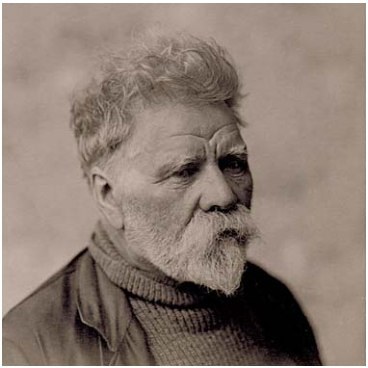
Augusts Dombrovskis
1845 – 1927
- Kapsēta
- Ziemeļblāzma Park, Riga, Latvia
Augusts Dombrovskis used the income from timber business to support education and cultural activity in Vecmīlgrāvis. His projects included schools, accommodation for writers and the Ziemeļblāzma cultural centre. A commitment to temperance shaped his ideas about a healthier and more resourceful community. Largely self-educated, he combined practical knowledge of industry and building with an interest in music and violin making. The institutions he supported offered spaces in which children could learn and adults could meet, perform and organise. His story is consequently about the use of wealth as well as its accumulation. Dombrovskis was born on 16 August 1845 in Ķengarags, Riga, into a poor fishing family. He never attended school, instead learning reading, writing and arithmetic independently, followed by foreign languages and skills in construction and architectural design. At fourteen he began working at the sawmill of his relative Jēkabs Dombrovskis. His work included floating timber along the Daugava towards Mīlgrāvis, near the river’s mouth. He also constructed lighters to make timber handling easier, adding practical improvements to the work through which he gained experience. [2] In 1887 he established a sawmill in Vecmīlgrāvis with three partners. The business was profitable, and its relationship with the surrounding settlement extended beyond wages and production. Workers wishing to build family homes could obtain timber from him at reduced prices and on extended credit. In 1900 he built the Zaļā skola, or Green School, and a kindergarten in Mīlgrāvis, providing the necessary teaching materials. Schooling was free for workers’ children, orphans and children from impoverished households, while kindergarten care and instruction were also provided without charge. [2] Gardening formed part of the kindergarten’s daily activity. Children cultivated flowers, vegetables, fruit trees and bushes rather than receiving instruction only indoors. To develop its educational work, Dombrovskis sent headmistress Marta Rinka to study in Germany. The institution subsequently became a place where other teachers could observe its practices and learn from them. Rinka also played a broader role in the social life of Vecmīlgrāvis and, after Dombrovskis’s death, managed his estate. Her work was thus connected both with his educational provision and with the community around it. [2] At a meeting of the Concord Society in 1903, Dombrovskis proposed adopting the name Ziemeļblāzma and prohibiting alcohol on its premises. He financed a society building, completed in 1904, which accommodated festivities, theatrical performances and concerts. Around it he laid out a park containing more than a thousand trees and shrubs, paths, constructed rock features and arbours. A tsarist punitive expedition burned the building in 1906, following the revolution of the previous year. Dombrovskis subsequently designed its replacement, which opened in 1913 with reinforced-concrete construction and a hall accommodating two thousand people. [2] The rebuilt centre also contained a dining facility, library and rooms for courses and meetings. His further educational and cultural undertakings included a pro-gymnasium founded in 1908 and the Burtnieki House, where people working in culture could rent inexpensive accommodation. Its residents included Jānis Akuraters, Krišjānis Barons, Jānis Poruks and Kārlis Skalbe. Dombrovskis gave financial assistance to Barons’s collection and organisation of Latvian folk songs. Theatre and music likewise remained prominent at Ziemeļblāzma, with outdoor performances and a documented concert devoted to the work of composer Emilis Melngailis in May 1911. [2] His enterprise was destroyed by fire during the First World War, and after rebuilding it no longer produced its former returns. Dombrovskis then devoted considerable attention to violin making. The chapter reports that he sold about 150 instruments of his own construction, several receiving exhibition awards. His book Mana vijole appeared in 1923. He died on 13 November 1927 and was buried in Ziemeļblāzma Park. Government ministers, military representatives, public figures and residents of Mīlgrāvis attended the funeral, bringing together people associated with both national institutions and the locality he had supported. [2]
Grāmatu “100 Latvijas personību”, kurā iekļauta arī šī personība, var iegādāties šeit.
The map marker shows the cemetery; the exact grave position is not yet established.
Sources & Further Reading
Books
- [2] Apinis, P. A Hundred Great Latvians. Nacionālais apgāds, Riga, 2006, pp. 28-29. ISBN 9984-26-288-X.