
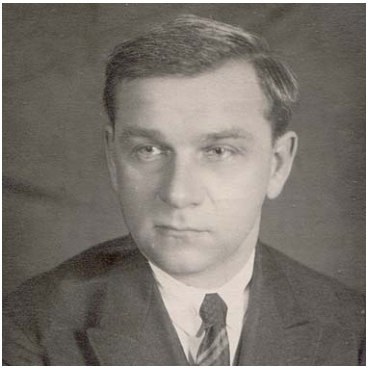
Arveds Švābe
1888 – 1959
- Kapsēta
- Norra begravningsplatsen / Northern Cemetery, Stockholm, Sweden; identified by the National Encyclopaedia
Arveds Švābe examined Latvia’s past through law, social history and archival research. His work helped shift attention toward the experiences and institutions of Latvian society, challenging accounts that treated the region mainly through the perspectives of its ruling elites. He taught, wrote and contributed to major reference works, combining scholarship with participation in the public life of independent Latvia. Exile in Sweden changed the conditions of his research but did not end it. His publications continued to provide material for readers separated from archives at home. The National Encyclopaedia identifies his burial in Stockholm’s Northern Cemetery. Švābe was born in Lielstraupe on 25 May 1888 and attended schools in Cēsis, Valmiera and Jelgava. His participation in the revolutionary movement of 1905 brought a death sentence, which he escaped. Through independent study he qualified to tutor mathematics in 1908 and science the following year. Between 1911 and 1915 he studied science and history at Moscow’s A. Shanyavsky People’s University. Its lecturers included scholars who had been dismissed from major universities in Moscow and St Petersburg because of their progressive views. [2] In 1916 he moved to the Far East, working in the postal service along the railway between Vladivostok and Harbin. Outside his employment he studied Latvian folklore and the poetry of China and Japan. Returning to Riga in November 1919, he joined the Baltic Department of the Ministry of Foreign Affairs. Election to the Constituent Assembly followed in 1920. While participating in the preparation of Latvia’s constitution, he pursued historical investigations and wrote schoolbooks, bringing his developing scholarship into both educational and public settings. [2] He completed a law degree at the University of Latvia in 1925. His academic appointments followed in stages: associate professor of Latvian legal history in 1929, professor in 1932, and professor of Latvian history in the Faculty of Philology and Philosophy from 1936. His legal and historical expertise also had an international application. When former Baltic German landowners challenged Latvia’s agrarian reform before the League of Nations and international legal institutions, Švābe represented Latvia and used historical evidence to answer their claims. [2] Agrarian history was central to his published research. His major study appeared in German in 1928, followed by revised English and French versions in 1929 and a Latvian edition in 1930. His investigations of the political organisation of ancient Latvia informed Straumes un avoti, published between 1938 and 1940. He also wrote a history covering Latvia from 1800 to 1914. Alongside these studies, he compiled and served as chief editor of Latviešu konversācijas vārdnīca, the extensive Latvian reference publication issued from 1927 to 1940. His writing ranged further into biography, literary criticism, folklore, poetry, prose and drama. [2] The successive occupations of Latvia disrupted this work. During 1940–1941 he served as deputy head of the university’s Latvian history chair. His name appeared on the list of people designated for deportation on 14 June 1941, but his absence from home enabled him to escape arrest. Under German occupation he directed the Depository of History. As Soviet forces approached in 1944, he left for Germany; in 1949 he moved to Sweden, where he worked in Stockholm University’s archive and continued historical and folkloric research. [2] In Sweden he edited the three-volume Latvian Encyclopaedia, published between 1950 and 1955, with amendments appearing in 1962. Its treatment of Latvia’s past disputed Soviet historical claims. Soviet ideologists responded by accusing him of falsification, and his name was removed from publications in Soviet Latvia. His death came in Stockholm on 20 August 1959. The later establishment of a Latvian history award bearing his name by the Latvian Academy of Sciences provides an institutional commemoration of his scholarship, alongside the historical studies and reference works he left to readers. [2]
Grāmatu “100 Latvijas personību”, kurā iekļauta arī šī personība, var iegādāties šeit.
The map marker shows the cemetery; the exact grave position is not yet established.
Sources & Further Reading
Books
- [2] Apinis, P. A Hundred Great Latvians. Nacionālais apgāds, Riga, 2006, pp. 96-97. ISBN 9984-26-288-X.
Web resources
- [1] Arveds Švābe