
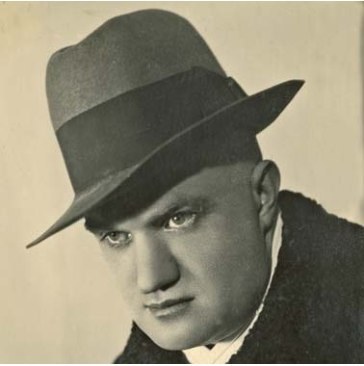
Aleksandrs Čaks
1901 – 1950
- Kapsēta
- Rainis Cemetery / Raiņa kapi, Riga, Latvia
Aleksandrs Čaks made the city a powerful presence in Latvian poetry. Streets, shop windows, cab drivers and people on society’s margins entered writing that expanded the subjects and rhythms of the literary language. His Riga could be intimate, restless and emotionally charged. Born Aleksandrs Čadarainis, he also wrote about the Latvian riflemen in Mūžības skartie. His career unfolded amid revolution, independence and successive occupations, and his relationship with Soviet literary authority became increasingly difficult. The tension between a distinctive artistic voice and official expectations is part of his history. He died in 1950. His work remains valuable for the way it notices lives and places that a more conventional public portrait of a city might leave out. Born in Riga on 27 October 1901, Čaks began his education at Alexander Gymnasium. The outbreak of the First World War displaced his family, and he continued his schooling at several institutions in Russia. He entered the medical faculty of Moscow University, but literary activities also occupied his time. He attended evenings and discussions involving Russian futurists and imaginists, and his early attempts at poetry were written in both Latvian and Russian. His education therefore brought medical study and encounters with experimental literary movements into the same period of his life. [2] In 1919 he was conscripted into the Red Army and assigned to a hospital train. His service took him through European Russia, Siberia and Turkmenistan, and included participation in fighting. Returning to Latvia in 1924, he studied medicine and philology before receiving a teaching licence in 1925. For the next three years he worked at Drabeši near Cēsis, serving as both teacher and school head. From 1928 to 1934 he held a clerical position in a savings bank. He later became a correspondent for Atpūta, the magazine published by Emīlija and Antons Benjamiņi. [2] His emergence as a published poet was closely connected with collective literary initiatives. In 1927 he and his associates established the publishing house Seši, which issued the journal Jauno Lira. Four collections followed over two years: Sirds uz trotuāra and Es un šis laiks in 1928, then Apašs frakā and Pasaules krogs in 1929. These books brought him popularity and an unusually favourable critical reception. He also participated in Zaļā vārna, an association of younger poets and artists, and in the oppositional literary newspaper Trauksme, published between 1928 and 1930. [2] The figure speaking in his poems should not be confused with a straightforward account of his daily conduct. His literary self could appear as a wanderer, a rough urban character or an artist outside conventional expectations, whereas his working life was generally quiet and conscientious. That contrast accompanied innovations in poetic form and subject matter which helped establish modern Latvian poetry. His writing extended well beyond verse: he produced plays, fiction, literary essays, reviews of films and literature, descriptive prose and articles on economic affairs. The practical occupations of his life coexisted with this varied literary output. [2] Published in 1937–1939, Mūžības skartie treated the Latvian riflemen’s experiences in the First World War and the Russian Civil War through an unconventional heroic epic. The occupations that followed disrupted his career. His poetic activity fell silent during the Soviet occupation beginning in 1940. Under German occupation he did not publish under his own name, although he continued to write productively. Much of the work created during that period remained unavailable to readers for roughly three decades, separating the circumstances of its composition from its eventual public reception. [2] After Soviet rule returned in 1944, Čaks worked for Cīņa, translated Russian fiction and wrote commissioned poems that were collected in three volumes. These activities did not protect him from official criticism: Soviet functionaries accused him of bourgeois nationalism and narrowness of outlook. The treatment caused him deep distress, and he experienced depression during his final years. He died on 8 February 1950, aged forty-eight, and was buried in Riga’s Rainis Cemetery. The later publication of his wartime writings made a previously inaccessible part of his creative life available beyond that constrained final period. [2]
Grāmatu “100 Latvijas personību”, kurā iekļauta arī šī personība, var iegādāties šeit.
The map marker shows the cemetery; the exact grave position is not yet established.
Sources & Further Reading
Books
- [2] Apinis, P. A Hundred Great Latvians. Nacionālais apgāds, Riga, 2006, pp. 118-119. ISBN 9984-26-288-X.