
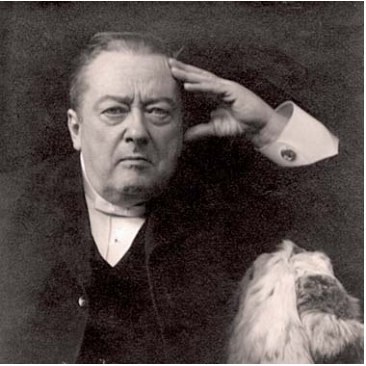
Ādolfs Alunāns
1848 – 1912
- Kapsēta
- Former Jāņa Cemetery, now Alunāns Park, Jelgava, Latvia
Ādolfs Alunāns helped turn Latvian-language theatre into a sustained public activity. He worked as an actor, director, organiser and playwright, supplying both performances and practical experience at a time when theatrical institutions were still developing. His comedies, touring work and writing about theatre encouraged audiences and performers to see the stage as part of Latvian cultural life. Rather than limiting himself to one artistic role, he addressed the need for plays, trained actors and regular contact with the public. The title often given to him, father of Latvian theatre, reflects this breadth of institution-building. His life is closely associated with Jelgava, where a memorial museum preserves his history. Born in Jelgava on 11 October 1848, Alunāns attended the Duke Peter German Gymnasium, where his early interest in theatre developed in a German-speaking environment. His first acting experience came at the German theatre in Dorpat, now Tartu. He subsequently appeared on German stages in Reval, now Tallinn, and St Petersburg. These engagements preceded his leadership of a Latvian company and gave him professional experience outside the language in which he would undertake his most consequential theatrical work. His career thus began within the established German theatrical world of the region. [2] A decisive opportunity came in 1869, during celebrations marking the laying of the Riga Latvian Society’s foundation stone. For that occasion he staged his own one-act work, Paša audzināts, identified as the first original Latvian play performed on stage. The following year he assumed management of the Society’s theatre, a position he retained until 1885. Under his direction it acquired a regular body of actors and became an independent Latvian company. This development coincided with the growing articulation of Latvian national identity through language, folklore and cultural institutions. [2] Alunāns supplied that company with more than administrative leadership. He translated and adapted German dramatic works, while also writing original material suited to the stage. In 1872 he directed Mucenieks un muceniece, his own work and the first Latvian operetta. His original dramatic output eventually amounted to twenty-two plays. Language was an important consideration in this writing: he favoured sentences that actors could deliver clearly and audiences could readily understand. His plays also circulated new Latvian words introduced by his uncle Juris Alunāns, Atis Kronvalds and himself, while their humorous expressions entered wider spoken usage. [2] The newspaper Baltijas Vēstnesis carried his article Kāds vārds par teātri, an early landmark as the first theoretical discussion of Latvian theatre written in Latvian. His writing about the stage ultimately extended to approximately a thousand articles. Alongside this substantial critical output, he produced around four hundred humorous and satirical poems, with his humorous and satirical writings collected in three volumes. Publishing was another sustained occupation. His Zobgala kalendārs appeared from 1892 to 1912, adding a widely recognised humorous publication to work otherwise closely connected with theatrical performance and debate. [2] In 1885 his working life shifted to Jelgava. There he established a theatre in 1896 and managed it until 1904; local audiences commonly associated the institution with his name. He also wrote books concerned with Latvian cultural figures and theatrical history. Ievērojami latvieši appeared during 1887–1890, followed by his account of Juris Alunāns’s life in 1910. His recollections of the beginnings of Latvian theatre were published in book form in 1924, after his death. These publications preserved accounts of cultural development alongside the plays through which he had participated in it. [2] Alunāns died in Jelgava on 5 July 1912 and was buried in Jāņa Cemetery, the site later known as Alunāns Park. His final home, at 3 Filozofu Street, where he lived from 1910 to 1912, became a memorial museum in 1968. The Jelgava People’s Theatre also retained his name. His dramatic work continued to be performed long after his lifetime: a 1955 production of Seši mazi bundzenieki at the Valmiera Drama Theatre is one documented example of its continuing place in Latvian theatrical repertory. [2]
Grāmatu “100 Latvijas personību”, kurā iekļauta arī šī personība, var iegādāties šeit.
The map marker shows the cemetery; the exact grave position is not yet established.
Sources & Further Reading
Books
- [2] Apinis, P. A Hundred Great Latvians. Nacionālais apgāds, Riga, 2006, pp. 32-33. ISBN 9984-26-288-X.